Name:
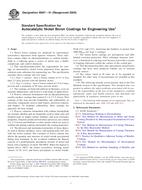
ASTM B607-91(2009) PDF
Published Date:
09/01/2009
Status:
Active
Publisher:
ASTM International
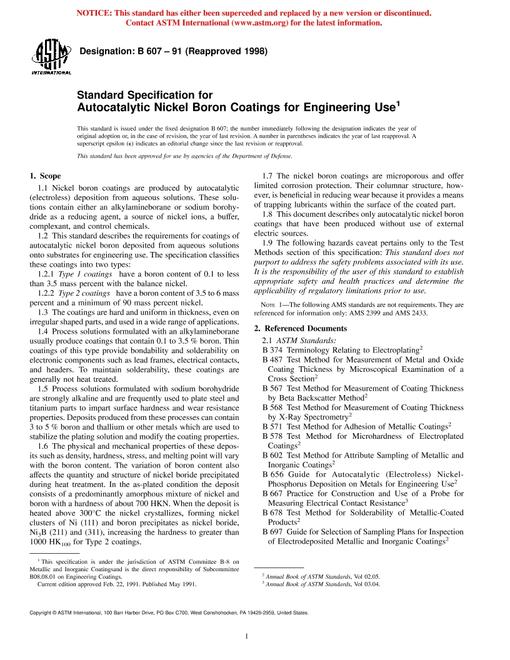
1.1 Nickel boron coatings are produced by autocatalytic (electroless) deposition from aqueous solutions. These solutions contain either an alkylamineborane or sodium borohydride as a reducing agent, a source of nickel ions, a buffer, complexant, and control chemicals.
1.2 This specificationdescribes the requirements for coatings of autocatalytic nickel boron deposited from aqueous solutions onto substrates for engineering use. The specification classifies these coatings into two types:
1.2.1 Type 1 coatings have a boron content of 0.1 to less than 3.5 mass percent with the balance nickel.
1.2.2 Type 2 coatings have a boron content of 3.5 to 6 mass percent and a minimum of 90 mass percent nickel.
1.3 The coatings are hard and uniform in thickness, even on irregular shaped parts, and used in a wide range of applications.
1.4 Process solutions formulated with an alkylamineborane usually produce coatings that contain 0.1 to 3.5 % boron. Thin coatings of this type provide bondability and solderability on electronic components such as lead frames, electrical contacts, and headers. To maintain solderability, these coatings are generally not heat treated.
1.5 Process solutions formulated with sodium borohydride are strongly alkaline and are frequently used to plate steel and titanium parts to impart surface hardness and wear resistance properties. Deposits produced from these processes can contain 3 to 5 % boron and thallium or other metals which are used to stabilize the plating solution and modify the coating properties.
1.6 The physical and mechanical properties of these deposits such as density, hardness, stress, and melting point will vary with the boron content. The variation of boron content also affects the quantity and structure of nickel boride precipitated during heat treatment. In the as-plated condition the deposit consists of a predominantly amorphous mixture of nickel and boron with a hardness of about 700 HKN. When the deposit is heated above 300°C the nickel crystallizes, forming nickel clusters of Ni (111) and boron precipitates as nickel boride, Ni3B (211) and (311), increasing the hardness to greater than 1000 HK100 for Type 2 coatings.
1.7 The nickel boron coatings are microporous and offer limited corrosion protection. Their columnar structure, however, is beneficial in reducing wear because it provides a means of trapping lubricants within the surface of the coated part.
1.8 This document describes only autocatalytic nickel boron coatings that have been produced without use of external electric sources.
1.9 The values stated in SI units are to be regarded as standard. No other units of measurement are included in this standard.
1.10 The following hazards caveat pertains only to the Test Methods section of this specification: This standard does not purport to address the safety problems associated with its use. It is the responsibility of the user of this standard to establish appropriate safety and health practices and determine the applicability of regulatory limitations prior to use.
Note 1 - The following AMS standards are not requirements. They are referenced for information only: AMS 2399 and AMS 2433.
X2.1.1 This test method will evaluate the resistance of the coating to abrasive wear. The test is performed on a rotating plated panel that is abraded by two rotating rubber wheels. The panel is weighed before and after each 1000 cycles for weight loss determination. Duration of the test is 5000 cycles and it can be extended to 25 000 cycles.
Note X2.1 - Variations in results have been attributed to the humidity in the laboratory and the storage conditions of the CS-10 wheels. Care should be taken to control the humidity between tests as recommended by the equipment manufacturer.
X2.1.2 The results are variable between tests and therefore three plated test specimens should be tested to 6000 cycles each. The results should be averaged without the first 1000 cycles and the abrasion wear resistance reported.
| File Size : | 1 file , 120 KB |
| Note : | This product is unavailable in Russia, Ukraine, Belarus |
| Number of Pages : | 6 |
| Published : | 09/01/2009 |
| Redline File Size : | 2 files , 230 KB |