Name:
ASTM B611-21 PDF
Published Date:
11/01/2021
Status:
Active
Publisher:
ASTM International
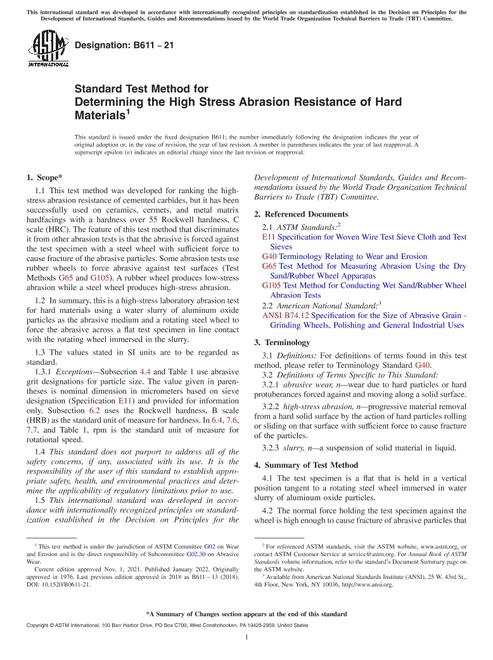
1.1''This test method was developed for ranking the high-stress abrasion resistance of cemented carbides, but it has been successfully used on ceramics, cermets, and metal matrix hardfacings with a hardness over 55 Rockwell hardness, C scale (HRC). The feature of this test method that discriminates it from other abrasion tests is that the abrasive is forced against the test specimen with a steel wheel with sufficient force to cause fracture of the abrasive particles. Some abrasion tests use rubber wheels to force abrasive against test surfaces (Test Methods G65 and G105). A rubber wheel produces low-stress abrasion while a steel wheel produces high-stress abrasion.
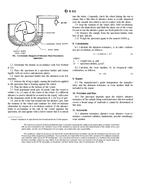
1.2''In summary, this is a high-stress laboratory abrasion test for hard materials using a water slurry of aluminum oxide particles as the abrasive medium and a rotating steel wheel to force the abrasive across a flat test specimen in line contact with the rotating wheel immersed in the slurry.
1.3''The values stated in SI units are to be regarded as standard.
1.3.1''Exceptions'''Subsection 4.4 and Table 1 use abrasive grit designations for particle size. The value given in parentheses is nominal dimension in micrometers based on sieve designation (Specification E11) and provided for information only. Subsection 6.2 uses the Rockwell hardness, B scale (HRB) as the standard unit of measure for hardness. In 6.4, 7.6, 7.7, and Table 1, rpm is the standard unit of measure for rotational speed.
1.4''This standard does not purport to address all of the safety concerns, if any, associated with its use. It is the responsibility of the user of this standard to establish appropriate safety, health, and environmental practices and determine the applicability of regulatory limitations prior to use.
1.5''This international standard was developed in accordance with internationally recognized principles on standardization established in the Decision on Principles for the Development of International Standards, Guides and Recommendations issued by the World Trade Organization Technical Barriers to Trade (TBT) Committee.
| File Size : | 1 file , 170 KB |
| Note : | This product is unavailable in Russia, Ukraine, Belarus |
| Number of Pages : | 7 |
| Published : | 11/01/2021 |
| Redline File Size : | 2 files , 370 KB |