ASTM C1165-90(2000)e1 PDF

ASTM C1165-90(2000)e1 PDF

Name:
ASTM C1165-90(2000)e1 PDF

Published Date:
08/10/2000

Status:
Active

Description:

Standard Test Method for Determining Plutonium by Controlled-Potential Coulometry in H2SO4 at a Platinum Working Electrode

Publisher:
ASTM International

Document status:
Active

Format:
Electronic (PDF)

Delivery time:
10 minutes

Delivery time (for Czech version):
200 business days

SKU:
astm-c1165-90-2000-e1_5876

Choose Document Language:
17.40 €
Need Help?

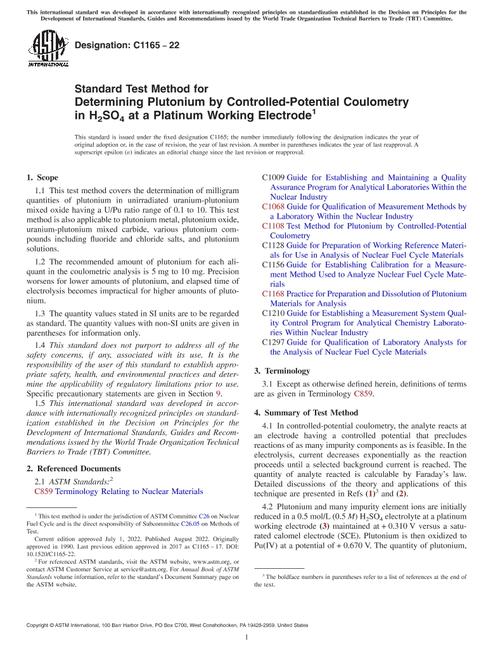
1.1 This test method describes the determination of milligram quantities of plutonium in unirradiated uranium-plutonium mixed oxide having a U/Pu ratio range of 0.1 to 10. This test method is also applicable to plutonium metal, plutonium oxide, uranium-plutonium mixed carbide, various plutonium compounds including fluoride and chloride salts, and plutonium solutions.

1.2 The recommended amount of plutonium for each aliquant in the coulometric analysis is 5 to 10 mg. Precision worsens for lower amounts of plutonium, and elapsed time of electrolysis becomes impractical for higher amounts of plutonium.

1.3 The values stated in SI units are to be regarded as standard.

1.4 This standard does not purport to address all of the safety concerns, if any, associated with its use. It is the responsibility of the user of this standard to establish appropriate safety and health practices and determine the applicability of regulatory limitations prior to use. Specific precautionary statements are given in Section 8.


File Size : 1 file , 80 KB
Note : This product is unavailable in Russia, Ukraine, Belarus
Number of Pages : 5
Published : 08/10/2000

History

ASTM C1165-23
Published Date: 01/01/2023
Standard Test Method for Determining Plutonium by Controlled-Potential Coulometry in H2SO4 at a Platinum Working Electrode
17.10 €
ASTM C1165-22
Published Date: 07/01/2022
Standard Test Method for Determining Plutonium by Controlled-Potential Coulometry in H2SO4 at a Platinum Working Electrode
20.40 €
ASTM C1165-17
Published Date: 11/01/2017
Standard Test Method for Determining Plutonium by Controlled-Potential Coulometry in H2SO4 at a Platinum Working Electrode
19.20 €
ASTM C1165-12
Published Date: 06/01/2012
Standard Test Method for Determining Plutonium by Controlled-Potential Coulometry in H2SO4 at a Platinum Working Electrode
18.00 €
ASTM C1165-90(2005)
Published Date: 06/01/2005
Standard Test Method for Determining Plutonium by Controlled-Potential Coulometry in H2SO4 at a Platinum Working Electrode
18.00 €
ASTM C1165-90(2000)e1
Published Date: 08/10/2000
Standard Test Method for Determining Plutonium by Controlled-Potential Coulometry in H2SO4 at a Platinum Working Electrode
17.40 €

Related products

ASTM C1111-10(2020)
Published Date: 12/01/2020
Standard Test Method for Determining Elements in Waste Streams by Inductively Coupled Plasma-Atomic Emission Spectroscopy
15.60 €
ASTM C996-20
Published Date: 03/01/2020
Standard Specification for Uranium Hexafluoride Enriched to Less Than 5% 235U
13.20 €
ASTM C1477-19
Published Date: 11/01/2019
Standard Test Method for Isotopic Abundance Analysis of Uranium Hexafluoride and Uranyl Nitrate Solutions by Multi-Collector, Inductively Coupled Plasma-Mass Spectrometry
15.00 €
ASTM C1128-23
Published Date: 01/01/2023
Standard Guide for Preparation of Working Reference Materials for Use in Analysis of Nuclear Fuel Cycle Materials
24.60 €

Best-Selling Products

AIAA G-003A-1996
Published Date: 01/01/1996
AIAA Guide to Reference and Standard Atmosphere Models (G-003A-1996e)
13.50 €
AIAA G-003B-2004
Published Date: 11/17/2004
Guide to Reference and Standard Atmosphere Models
13.50 €
AIAA G-003C-2010(2016)
Published Date: 10/01/2010
Guide to Reference and Standard Atmosphere Models
AIAA G-010-1993
Published Date: 01/01/1993
AIAA Guide for Reusable Software: Assessment Criteria for Aerospace Applications (G-010-1993e)
AIAA G-034-1998
Published Date: 01/01/1999
AIAA Guide to Reference and Standard Ionosphere Models (G-034-1998e)
15.90 €
AIAA G-034A-2014(2019)
Published Date: 05/01/2014
Guide to Reference and Standard Ionosphere Models