Name:
ASTM C335-05ae1 PDF
Published Date:
06/01/2005
Status:
Active
Publisher:
ASTM International
1.1 This test method covers the measurement of the steady-state heat transfer properties of pipe insulations. Specimen types include rigid, flexible, and loose fill; homogeneous and nonhomogeneous; isotropic and nonisotropic; circular or non-circular cross section. Measurement of metallic reflective insulation and mass insulations with metal jackets or other elements of high axial conductance is included; however, additional precautions must be taken and specified special procedures must be followed.
1.2 The test apparatus for this purpose is a guarded-end or calibrated-end pipe apparatus. The guarded-end apparatus is a primary (or absolute) method. The guarded-end method is comparable, but not identical to ISO 8497.
1.3 When appropriate, or as required by specifications or other test methods, the following thermal transfer properties for the specimen can be calculated from the measured data (see 3.2):
1.3.1 The pipe insulation lineal thermal resistance and conductance,
1.3.2 The pipe insulation lineal thermal transference,
1.3.3 The surface areal resistance and heat transfer coefficient,
1.3.4 The thermal resistivity and conductivity,
1.3.5 The areal thermal resistance and conductance, and
1.3.6 The areal thermal transference.
Note 1 - In this test method the preferred resistance, conductance, and transference are the lineal values computed for a unit length of pipe. These must not be confused with the corresponding areal properties computed on a unit area basis which are more applicable to flat slab geometry. If these areal properties are computed, the area used in their computation must be reported.
Note 2 - Discussions of the appropriateness of these properties to particular specimens or materials may be found in Test Method C 177, Test Method C 518, and in the literature (1)².
1.4 This test method allows for operation over a wide range of temperatures. The upper and lower limit of the pipe surface temperature is determined by the maximum and minimum service temperature of the specimen or of the materials used in constructing the apparatus. In any case, the apparatus must be operated such that the temperature difference between the exposed surface and the ambient is sufficiently large enough to provide the precision of measurement desired. Normally the apparatus is operated in closely controlled still air ambient from 15 to 30C, but other temperatures, other gases, and other velocities are acceptable. It is also acceptable to control the outer specimen surface temperature by the use of a heated or cooled outer sheath or blanket or by the use of an additional uniform layer of insulation.
1.5 The use any size or shape of test pipe is allowable provided that it matches the specimens to be tested. Normally the test method is used with circular pipes; however, its use is permitted with pipes or ducts of noncircular cross section (square, rectangular, hexagonal, etc.). One common size used for interlaboratory comparison is a pipe with a circular cross section of 88.9-mm diameter (standard nominal 80-mm (3-in.) pipe size), although several other sizes are reported in the literature ().
1.6 The test method applies only to test pipes with a horizontal or vertical axis. For the horizontal axis, the literature includes using the guarded-end, the calibrated, and the calibrated-end cap methods. For the vertical axis, no experience has been found to support the use of the calibrated or calibrated-end methods. Therefore the method is restricted to using the guarded-end pipe apparatus for vertical axis measurements.
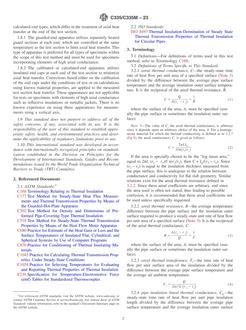
1.7 This test method covers two distinctly different types of pipe apparatus, the guarded-end and the calibrated or calculated-end types, which differ in the treatment of axial heat transfer at the end of the test section.
1.7.1 The guarded-end apparatus utilizes separately heated guard sections at each end, which are controlled at the same temperature as the test section to limit axial heat transfer. This type of apparatus is preferred for all types of specimens within the scope of this test method and must be used for specimens incorporating elements of high axial conductance.
1.7.2 The calibrated or calculated-end apparatus utilizes insulated end caps at each end of the test section to minimize axial heat transfer. Corrections based either on the calibration of the end caps under the conditions of test or on calculations using known material properties, are applied to the measured test section heat transfer. These apparatuses are not applicable for tests on specimens with elements of high axial conductance such as reflective insulations or metallic jackets. There is no known experience on using these apparatuses for measurements using a vertical axis.
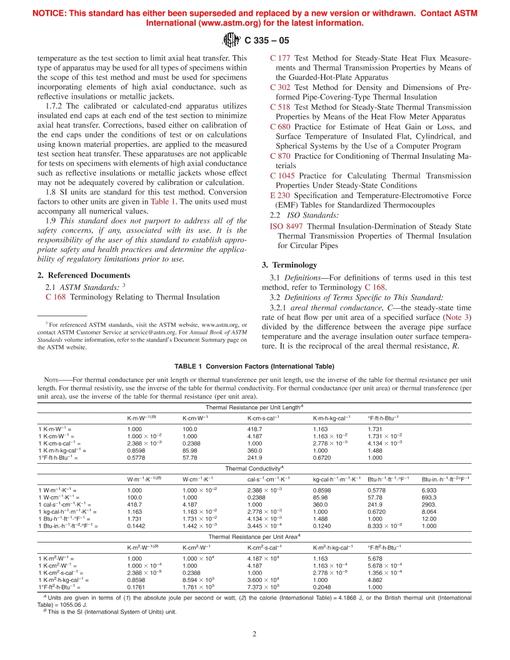
1.8 SI units are standard for this test method. Conversion factors to other units are given in Table 1. The units used must accompany all numerical values.
1.9 This standard does not purport to address all of the safety concerns, if any, associated with its use. It is the responsibility of the user of this standard to establish appropriate safety and health practices and determine the applicability of regulatory limitations prior to use.
| File Size : | 1 file , 180 KB |
| Note : | This product is unavailable in Russia, Ukraine, Belarus |
| Number of Pages : | 13 |
| Published : | 06/01/2005 |
| Redline File Size : | 2 files , 350 KB |