Name:
ASTM D256-04 PDF
Published Date:
05/01/2004
Status:
Active
Publisher:
ASTM International
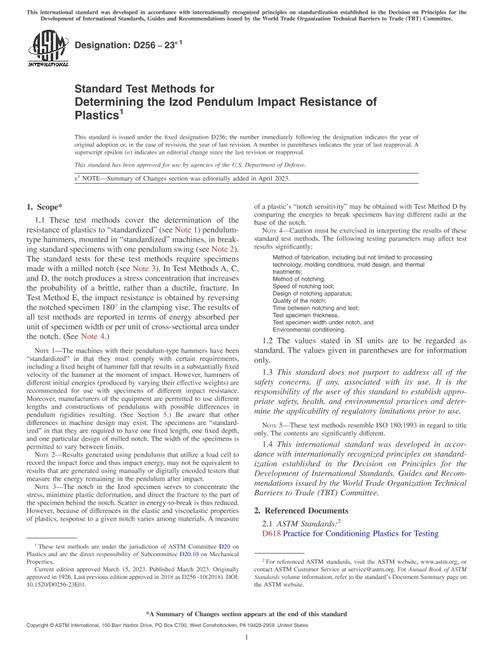
1.1 These test methods cover the determination of the resistance of plastics to "standardized" (see Note 1) pendulum-type hammers, mounted in "standardized" machines, in breaking standard specimens with one pendulum swing (see Note 2). The standard tests for these test methods require specimens made with a milled notch (see Note 3). In Test Methods A, C, and D, the notch produces a stress concentration that increases the probability of a brittle, rather than a ductile, fracture. In Test Method E, the impact resistance is obtained breakage by flexural shock as indicated by the energy extracted from by reversing the notched specimen 180° in the clamping vise. The results of all test methods are reported in terms of energy absorbed per unit of specimen width or per unit of cross-sectional area under the notch. (See Note 4.)
Note 1 - The machines with their pendulum-type hammers have been "standardized" in that they must comply with certain requirements, including a fixed height of hammer fall that results in a substantially fixed velocity of the hammer at the moment of impact. However, hammers of different initial energies (produced by varying their effective weights) are recommended for use with specimens of different impact resistance. Moreover, manufacturers of the equipment are permitted to use different lengths and constructions of pendulums with possible differences in pendulum rigidities resulting. (See Section 5.) Be aware that other differences in machine design may exist. The specimens are "standardized" in that they are required to have one fixed length, one fixed depth, and one particular design of milled notch. The width of the specimens is permitted to vary between limits.
Note 2 - Results generated using pendulums that utilize a load cell to record the impact force and thus impact energy, may not be equivalent to results that are generated using manually or digitally encoded testers that measure the energy remaining in the pendulum after impact.
Note 3 - The notch in the Izod specimen serves to concentrate the stress, minimize plastic deformation, and direct the fracture to the part of the specimen behind the notch. Scatter in energy-to-break is thus reduced. However, because of differences in the elastic and viscoelastic properties of plastics, response to a given notch varies among materials. A measure of a plastic's "notch sensitivity" may be obtained with Test Method D by comparing the energies to break specimens having different radii at the base of the notch.
Note 4 - Caution must be exercised in interpreting the results of these standard test methods. The following testing parameters may affect test results significantly:
Method of fabrication, including but not limited to processingtechnology, molding conditions, mold design, and thermaltreatments;Method of notching;Speed of notching tool;Design of notching apparatus;Quality of the notch;Time between notching and test;Test specimen thickness,Test specimen width under notch, andEnvironmental conditioning.1.2 The values stated in SI units are to be regarded as the standard. The values given in brackets are for information only.
1.3 This standard does not purport to address all of the safety concerns, if any, associated with its use. It is the responsibility of the user of this standard to establish appropriate safety and health practices and determine the applicability of regulatory limitations prior to use.
Note 5 - These test methods resemble ISO 180:1993 in regard to title only. The contents are significantly different.
| File Size : | 1 file , 330 KB |
| Note : | This product is unavailable in Russia, Ukraine, Belarus |
| Number of Pages : | 20 |
| Published : | 05/01/2004 |