Name:
ASTM D378-00(2008) PDF
Published Date:
01/01/2008
Status:
Active
Publisher:
ASTM International
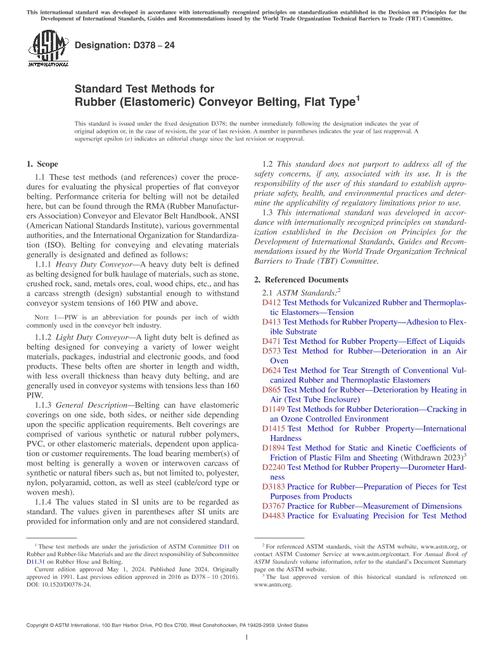
1.1 These test methods (and references) cover the procedures for evaluating the physical properties of flat conveyor belting. Performance criteria for belting will not be detailed here, but can be found through the RMA (Rubber Manufacturers Association) Conveyor and Elevator Belt Handbook, ANSI (American National Standards Institute), various governmental authorities, and the International Organization for Standardization (ISO). Belting for conveying and elevating materials generally is designated and defined as follows:
1.1.1 Heavy Duty Conveyor - A heavy duty belt is defined as belting designed for bulk haulage of materials, such as stone, crushed rock, sand, metals ores, coal, wood chips, etc., and has a carcass strength (design) substantial enough to withstand conveyor system tensions of 160 PIW (pounds per inch of width) and above.
1.1.2 Light Duty Conveyor - A light duty belt is defined as belting designed for conveying a variety of lower weight (density) materials, packages, industrial and electronic goods, and food products. These belts often are shorter in length and width, with less overall thickness than heavy duty belting, and are generally used in conveyor systems with tensions less than 160 PIW.
1.1.3 General Description - Belting can have elastomeric coverings on one side, both sides, or neither side depending upon the specific application requirements. Belt coverings are comprised of various synthetic or natural rubber polymers, PVC, or other elastomeric materials, dependent upon application or customer requirements. The strength (load bearing) member(s) of most belting generally is a woven or interwoven carcass of synthetic or natural fibers, such as, but not limited to, polyester, nylon, polyaramide and cotton, as well as steel (cable/cord type or woven mesh).
1.2 This standard does not purport to address all of the application specific testing available or safety concerns, if any, associated with its use. It is the responsibility of the user of this standard to establish appropriate safety and health practices and determine the applicability of regulatory limitations prior to use.
| File Size : | 1 file , 220 KB |
| Note : | This product is unavailable in Russia, Ukraine, Belarus |
| Number of Pages : | 13 |
| Published : | 01/01/2008 |
| Redline File Size : | 2 files , 460 KB |