Name:
ASTM D3826-98(2013) PDF
Published Date:
02/01/2013
Status:
Active
Publisher:
ASTM International
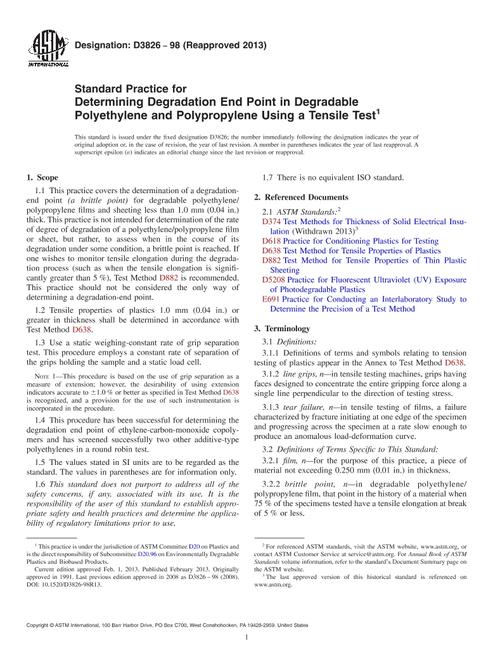
1.1 This practice covers the determination of a degradation-end point (a brittle point) for degradable polyethylene/polypropylene films and sheeting less than 1.0 mm (0.04 in.) thick. This practice is not intended for determination of the rate of degree of degradation of a polyethylene/polypropylene film or sheet, but rather, to assess when in the course of its degradation under some condition, a brittle point is reached. If one wishes to monitor tensile elongation during the degradation process (such as when the tensile elongation is significantly greater than 5 %), Test Method D882 is recommended. This practice should not be considered the only way of determining a degradation-end point.
1.2 Tensile properties of plastics 1.0 mm (0.04 in.) or greater in thickness shall be determined in accordance with Test Method D638.
1.3 Use a static weighing-constant rate of grip separation test. This procedure employs a constant rate of separation of the grips holding the sample and a static load cell.
Note 1-This procedure is based on the use of grip separation as a measure of extension; however, the desirability of using extension indicators accurate to ±1.0 % or better as specified in Test Method D638 is recognized, and a provision for the use of such instrumentation is incorporated in the procedure.1.4 This procedure has been successful for determining the degradation end point of ethylene-carbon-monoxide copolymers and has screened successfully two other additive-type polyethylenes in a round robin test.
1.5 The values stated in SI units are to be regarded as the standard. The values in parentheses are for information only.
1.6 This standard does not purport to address all of the safety concerns, if any, associated with its use. It is the responsibility of the user of this standard to establish appropriate safety and health practices and determine the applicability of regulatory limitations prior to use.
1.7 There is no equivalent ISO standard.
| File Size : | 1 file , 72 KB |
| Note : | This product is unavailable in Russia, Ukraine, Belarus |
| Number of Pages : | 4 |
| Published : | 02/01/2013 |