ASTM D4603-96 PDF

ASTM D4603-96 PDF

Name:
ASTM D4603-96 PDF

Published Date:
11/10/1996

Status:
Active

Description:

Standard Test Method for Determining Inherent Viscosity of Poly(Ethylene Terephthalate) (PET) by Glass Capillary Viscometer

Publisher:
ASTM International

Document status:
Active

Format:
Electronic (PDF)

Delivery time:
10 minutes

Delivery time (for Russian version):
200 business days

SKU:

Choose Document Language:
$15
Need Help?

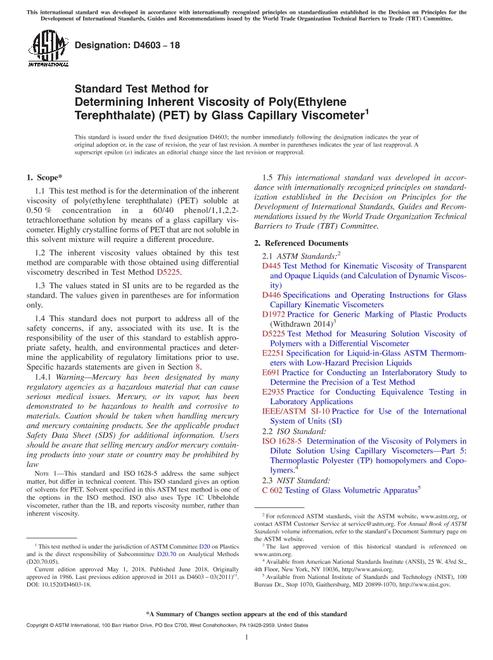
1.1 This test method is for the determination of the inherent viscosity of poly(ethylene terephthalate) (PET) soluble at 0.50% concentration in a 60/40 phenol/1,1,2,2-tetrachloroethane solution by means of a glass capillary viscometer. Some highly crystalline forms of PET may not be soluble in this solvent mixture and will require a different procedure.

1.2 The inherent viscosity values obtained by this test method are comparable with those obtained using differential viscometry described in Test Method D 5225.

1.3 The values stated in SI units are to be regarded as the standard. The values given in parentheses are for information only.

1.3 This standard does not purport to address all of the safety concerns, if any, associated with its use. It is the responsibility of the user of this standard to establish appropriate safety and health practices and determine the applicability of regulatory limitations prior to use. Specific hazards statements are given in Section 8.


File Size : 1 file , 41 KB
Note : This product is unavailable in Russia, Ukraine, Belarus
Number of Pages : 4
Published : 11/10/1996

History

ASTM D4603-18
Published Date: 05/01/2018
Standard Test Method for Determining Inherent Viscosity of Poly(Ethylene Terephthalate) (PET) by Glass Capillary Viscometer
$12.6
ASTM D4603-03(2011)e1
Published Date: 11/15/2011
Standard Test Method for Determining Inherent Viscosity of Poly(Ethylene Terephthalate) (PET) by Glass Capillary Viscometer
$15.6
ASTM D4603-03
Published Date: 03/10/2003
Standard Test Method for Determining Inherent Viscosity of Poly(Ethylene Terephthalate) (PET) by Glass Capillary Viscometer
$15.6
ASTM D4603-96
Published Date: 11/10/1996
Standard Test Method for Determining Inherent Viscosity of Poly(Ethylene Terephthalate) (PET) by Glass Capillary Viscometer
$15

Related products

ASTM D5507-21a
Published Date: 05/01/2021
Standard Test Method for Determination of Trace Organic Impurities in Monomer Grade Vinyl Chloride by Capillary Column/Multidimensional Gas Chromatography
$15.6
ASTM D5930-17
Published Date: 08/01/2017
Standard Test Method for Thermal Conductivity of Plastics by Means of a Transient Line-Source Technique
$14.4
ASTM D6394-21a
Published Date: 05/01/2021
Standard Classification System for and Basis for Specification for Sulfone Plastics (SP)
$15.6
ASTM D6779-23
Published Date: 03/15/2023
Standard Classification System for and Basis of Specification for Polyamide Molding and Extrusion Materials (PA)
$18.9

Best-Selling Products

SN-CEN/TS 1007-7:2006
Published Date: 09/27/2006
Advanced technical ceramics — Ceramic composites. Methods of test for reinforcements — Part 7: Determination of the distribution of tensile strength and of tensile strain to failure of filaments within a multifilament tow at high temperature
SN-CEN/TS 1046:2021
Published Date: 06/22/2021
Thermoplastics piping and ducting systems - Outside the building structures for gravity and pressurised systems - Trench installation
SN-CEN/TS 1071-10:2004
Published Date: 07/21/2004
Advanced technical ceramics — Methods of test for ceramic coatings — Part 10: Determination of coating thickness by cross sectioning
SN-CEN/TS 1071-11:2005
Published Date: 10/19/2005
Advanced technical ceramics — Methods of test for ceramic coatings — Part 11: Determination of internal stress by the Stoney formula
SN-CEN/TS 1071-8:2004
Published Date: 09/01/2004
Advanced technical ceramics — Methods of test for ceramic coatings — Part 8: Rockwell indentation test for evaluation of adhesion
SN-CEN/TS 1071-9:2004
Published Date: 02/11/2004
Advanced technical ceramics — Methods of test for ceramic coatings — Part 9: Determination of fracture strain