Name:
ASTM D5299-99 PDF
Published Date:
12/10/1999
Status:
Active
Publisher:
ASTM International
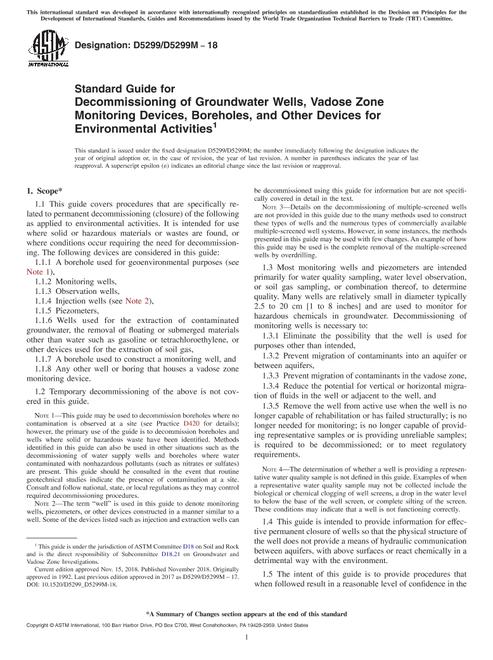
1.1 This guide covers procedures that are specifically related to permanent decommissioning (closure) of the following as applied to environmental activities. It is intended for use where solid or hazardous materials or wastes are found, or where conditions occur requiring the need for decommissioning. The following devices are considered in this guide:
1.1.1 A borehole used for geoenvironmental purposes (see Note 1),
1.1.2 Monitoring wells,
1.1.3 Observation wells,
1.1.4 Injection wells (see Note 2),
1.1.5 Piezometers,
1.1.6 Wells used for the extraction of contaminated ground water, the removal of floating or submerged materials other than water such as gasoline or tetrachloroethylene, or other devices used for the extraction of soil gas,
1.1.7 A borehole used to construct a monitoring well, and
1.1.8 Any other vadose zone monitoring device.
1.2 Temporary decommissioning of the above is not covered in this guide.
Note 1-This guide may be used to decommission boreholes where no contamination is observed at a site (see Practice1.3 Most monitoring wells and piezometers are intended primarily for water quality sampling, water level observation, or soil gas sampling, or combination thereof, to determine quality. Many wells are relatively small in diameter (<4-in. (10.1 cm) inside diameter) and are used to monitor for hazardous chemicals in ground water. Decommissioning of monitoring wells is necessary to:
1.3.1 Eliminate the possibility that the well is used for purposes other than intended,
1.3.2 Prevent migration of contaminants into an aquifer or between aquifers,
1.3.3 Prevent migration of contaminants in the vadose zone,
1.3.4 Reduce the potential for vertical or horizontal migration of fluids in the well or adjacent to the well, and
1.3.5 Remove the well from active use when the well is no longer capable of rehabilitation, or has failed structurally; no longer required for monitoring; no longer capable of providing representative samples or is providing unreliable samples; or required to be decommissioned; or to meet regulatory requirements.
Note 4-The determination of whether a well is providing a representative water quality sample is not defined in this guide. Examples of when a representative water quality sample may not be collected include the biological or chemical clogging of well screens, a drop in water level to below the base of the well screen, or complete silting of a tail pipe. These conditions may indicate that a well is not functioning properly.1.4 This guide is intended to provide information for effective permanent closure of wells so that the physical structure of the well does not provide a means of hydraulic communication between aquifers or react chemically in a detrimental way with the environment.
1.5 The intent of this guide is to provide procedures that when followed result in a reasonable level of confidence in the integrity of the decommissioning activity. However, it may not be possible to verify the integrity of the decommissioning procedure. At this time, methods are not available to substantially determine the integrity of the decommissioning activity.
1.6 The values stated in inch-pound units are to be regarded as the standard. The SI units given in parentheses are for information only.
1.7 This standard does not purport to address all of the safety problems, if any, associated with its use. It is the responsibility of the user of this standard to establish appropriate safety and health practices and determine the applicability of regulatory limitations prior to use.
Note 5-If state and local regulations are in effect where the decommissioning is to occur, the regulations take precedence over this guide.| File Size : | 1 file , 170 KB |
| Note : | This product is unavailable in Russia, Ukraine, Belarus |
| Number of Pages : | 16 |
| Published : | 12/10/1999 |