Name:
ASTM D5407-95(2000) PDF
Published Date:
01/01/2000
Status:
[ Withdrawn ]
Publisher:
ASTM International
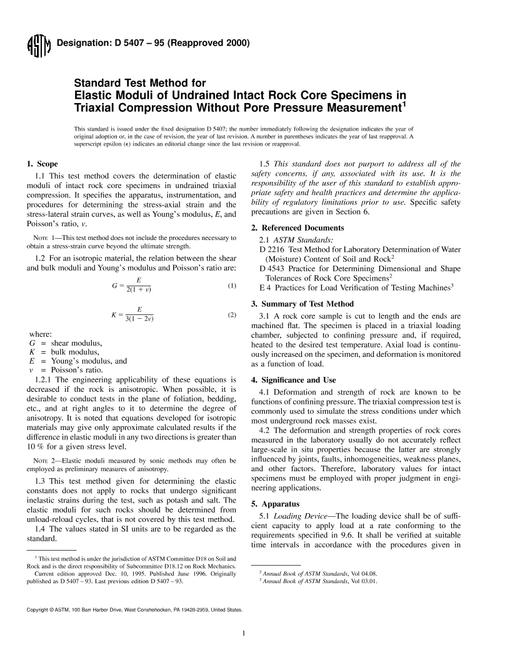
1.1 This test method covers the determination of elastic moduli of intact rock core specimens in undrained triaxial compression. It specifies the apparatus, instrumentation, and procedures for determining the stress-axial strain and the stress-lateral strain curves, as well as Young's modulus, E, and Poisson's ratio, v.
Note 1--This test method does not include the procedures necessary to obtain a stress-strain curve beyond the ultimate strength.
1.2 For an isotropic material, the relation between the shear and bulk moduli and Young's modulus and Poisson's ratio are: Equation 1 - G = E/2(1 + v) Equation 2 - K = E/3(1 - 2v)
where:
G = shear modulus,
K = bulk modulus,
E = Young's modulus, and
v = Poisson's ratio.
1.2.1 The engineering applicability of these equations is decreased if the rock is anisotropic. When possible, it is desirable to conduct tests in the plane of foliation, bedding, etc., and at right angles to it to determine the degree of anisotropy. It is noted that equations developed for isotropic materials may give only approximate calculated results if the difference in elastic moduli in any two directions is greater than 10 % for a given stress level.
Note 2--Elastic moduli measured by sonic methods may often be employed as preliminary measures of anisotropy.
1.3 This test method given for determining the elastic constants does not apply to rocks that undergo significant inelastic strains during the test, such as potash and salt. The elastic moduli for such rocks should be determined from unload-reload cycles, that is not covered by this test method.
1.4 The values stated in SI units are to be regarded as the standard.
1.5 This standard does not purport to address all of the safety concerns, if any, associated with its use. It is the responsibility of the user of this standard to establish appropriate safety and health practices and determine the applicability of regulatory limitations prior to use. Specific safety precautions are given in Section 6.
| File Size : | 1 file , 56 KB |
| Note : | This product is unavailable in Russia, Ukraine, Belarus |
| Number of Pages : | 6 |
| Published : | 01/01/2000 |