ASTM D5972-99ae1 PDF

ASTM D5972-99ae1 PDF

Name:
ASTM D5972-99ae1 PDF

Published Date:
12/10/1999

Status:
Active

Description:

Standard Test Method for Freezing Point of Aviation Fuels (Automatic Phase Transition Method)

Publisher:
ASTM International

Document status:
Active

Format:
Electronic (PDF)

Delivery time:
10 minutes

Delivery time (for Czech version):
200 business days

SKU:
astm-d5972-99ae1_1166448

Choose Document Language:
18.60 €
Need Help?

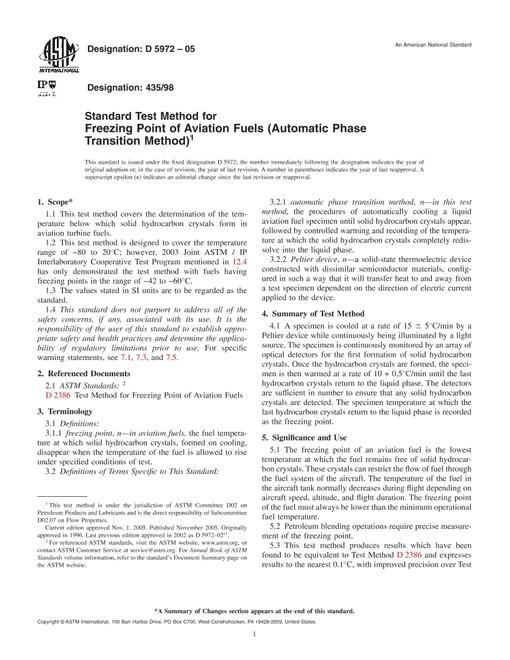
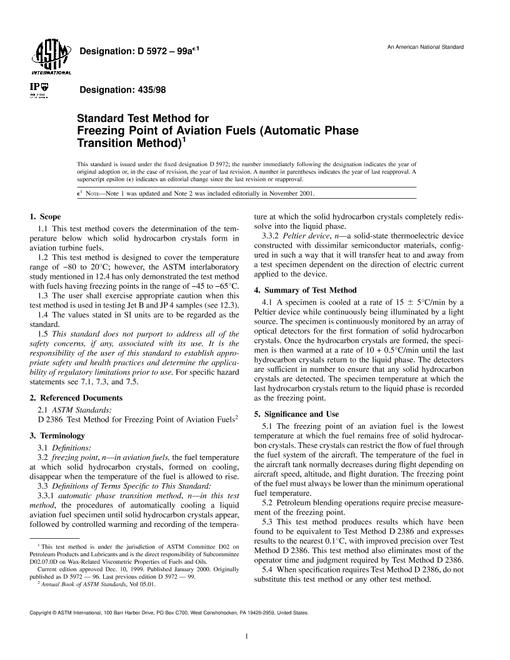
1.1 This test method covers the determination of the temperature below which solid hydrocarbon crystals form in aviation turbine fuels.

1.2 This test method is designed to cover the temperature range of -80 to 20°C; however, the ASTM interlaboratory study mentioned in 12.4 has only demonstrated the test method with fuels having freezing points in the range of -45 to 65°C.

1.3 The user shall exercise appropriate caution when this test method is used in testing Jet B and JP 4 samples (see 12.3).

1.4 The values stated in SI units are to be regarded as the standard.

1.5 This standard does not purport to address all of the safety concerns, if any, associated with its use. It is the responsibility of the user of this standard to establish appropriate safety and health practices and determine the applicability of regulatory limitations prior to use. For specific hazard statements see 7.1, 7.3, and 7.5.


File Size : 1 file , 71 KB
Note : This product is unavailable in Russia, Ukraine, Belarus
Number of Pages : 5
Published : 12/10/1999

History

ASTM D5972-23
Published Date: 03/01/2023
Standard Test Method for Freezing Point of Aviation Fuels (Automatic Phase Transition Method)<rangeref></rangeref >
17.10 €
ASTM D5972-05(2010)
Published Date: 05/01/2010
Standard Test Method for Freezing Point of Aviation Fuels (Automatic Phase Transition Method)
18.00 €
ASTM D5972-05e1
Published Date: 11/01/2005
Standard Test Method for Freezing Point of Aviation Fuels (Automatic Phase Transition Method)
18.00 €
ASTM D5972-05
Published Date: 11/01/2005
Standard Test Method for Freezing Point of Aviation Fuels (Automatic Phase Transition Method)
18.00 €
ASTM D5972-02e1
Published Date: 04/10/2002
Standard Test Method for Freezing Point of Aviation Fuels (Automatic Phase Transition Method)
18.00 €
ASTM D5972-02
Published Date: 04/10/2002
Standard Test Method for Freezing Point of Aviation Fuels (Automatic Phase Transition Method)
18.00 €
ASTM D5972-99ae1
Published Date: 12/10/1999
Standard Test Method for Freezing Point of Aviation Fuels (Automatic Phase Transition Method)
18.60 €
ASTM D5972-99a
Published Date: 12/10/1999
Standard Test Method for Freezing Point of Aviation Fuels (Automatic Phase Transition Method)
17.40 €

Related products

ASTM D4057-22
Published Date: 05/01/2022
Standard Practice for Manual Sampling of Petroleum and Petroleum Products
26.70 €
ASTM D4636-17
Published Date: 06/01/2017
Standard Test Method for Corrosiveness and Oxidation Stability of Hydraulic Oils, Aircraft Turbine Engine Lubricants, and Other Highly Refined Oils
16.20 €
ASTM D4741-21
Published Date: 01/01/2021
Standard Test Method for Measuring Viscosity at High Temperature and High Shear Rate by Tapered-Plug Viscometer
15.60 €
ASTM D5452-23
Published Date: 05/01/2023
Standard Test Method for Particulate Contamination in Aviation Fuels by Laboratory Filtration
17.10 €

Best-Selling Products

SN-ISO/IEC Guide 14:2018
Published Date: 07/13/2018
Products and related services — Information for consumers
SN-ISO/IEC Guide 41:2018
Published Date: 11/01/2018
Packaging — Recommendations for addressing consumer needs
SN-ISO/IEC Guide 71:2001
Published Date: 11/20/2002
Guidelines for standards developers to address the needs of older persons and persons with disabilities
SN-ISO/IEC Guide 73:2002
Published Date: 05/01/2006
Risk management — Vocabulary — Guidelines for use in standards
SN-ISO/IEC Guide 76:2008
Published Date: 01/16/2008
Development of service standards — Recommendations for addressing consumer issues
SN-ISO/IEC Guide 98-6:2021
Published Date: 03/22/2021
Uncertainty of measurement — Part 6: Developing and using measurement models