ASTM D5991-09 PDF

ASTM D5991-09 PDF

Name:
ASTM D5991-09 PDF

Published Date:
02/01/2009

Status:
Active

Description:

Standard Practice for Separation and Identification of Poly(Vinyl Chloride) (PVC) Contamination in Poly(Ethylene Terephthalate) (PET) Flake

Publisher:
ASTM International

Document status:
Active

Format:
Electronic (PDF)

Delivery time:
10 minutes

Delivery time (for Russian version):
200 business days

SKU:

Choose Document Language:
$15.6
Need Help?

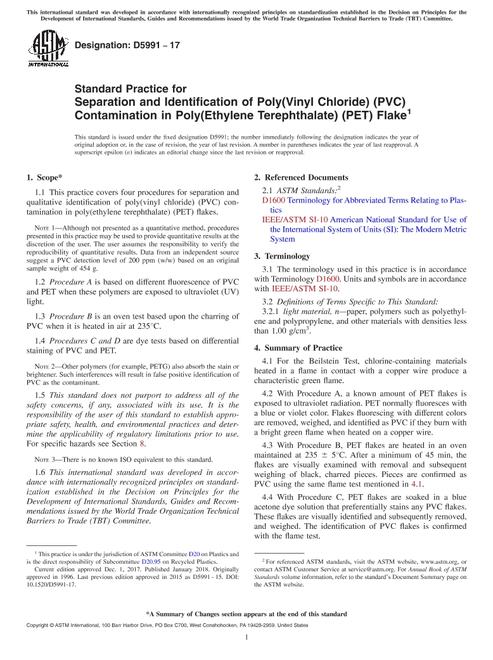
1.1 This practice covers four procedures for separation and qualitative identification of poly(vinyl chloride) (PVC) contamination in poly(ethylene terephthalate) (PET) flakes.

Note 1 - Although not presented as a quantitative method, procedures presented in this practice may be used to provide quantitative results at the discretion of the user. The user assumes the responsibility to verify the reproducibility of quantitative results. Data from an independent source suggest a PVC detection level of 200 ppm (w/w) based on an original sample weight of 454 g.

1.2 Procedure A is based on different fluorescence of PVC and PET when these polymers are exposed to ultraviolet (UV) light.

1.3 Procedure B is an oven test based upon the charring of PVC when it is heated in air at 235°C.

1.4 Procedures C and D are dye tests based on differential staining of PVC and PET.

Note 2 - Other polymers (for example, PETG) also absorb the stain or brightener. Such interferences will result in false positive identification of PVC as the contaminant.

1.5 This standard does not purport to address all of the safety concerns, if any, associated with its use. It is the responsibility of the user of this standard to establish appropriate safety and health practices and determine the applicability of regulatory limitations prior to use. For specific hazards see Section 8.

Note 3 - There is no known ISO equivalent to this practice.


File Size : 1 file , 69 KB
Note : This product is unavailable in Russia, Ukraine, Belarus
Number of Pages : 3
Published : 02/01/2009
Redline File Size : 2 files , 130 KB

History

ASTM D5991-23
Published Date: 02/01/2023
Standard Practice for Separation and Identification of Poly(Vinyl Chloride) (PVC) Contamination in Poly(Ethylene Terephthalate) (PET) Flake
$15
ASTM D5991-17
Published Date: 12/01/2017
Standard Practice for Separation and Identification of Poly(Vinyl Chloride) (PVC) Contamination in Poly(Ethylene Terephthalate) (PET) Flake
$18
ASTM D5991-09
Published Date: 02/01/2009
Standard Practice for Separation and Identification of Poly(Vinyl Chloride) (PVC) Contamination in Poly(Ethylene Terephthalate) (PET) Flake
$15.6
ASTM D5991-96(2002)
Published Date: 07/10/1996
Standard Practice for Separation and Identification of Poly(Vinyl Chloride) (PVC) Contamination in Poly(Ethylene Terephthalate) (PET) Flake
$15.6

Related products

ASTM D4476-09
Published Date: 09/01/2009
Standard Test Method for Flexural Properties of Fiber Reinforced Pultruded Plastic Rods
$18
ASTM D5209-92
Published Date: 07/31/1992
Standard Test Method for Determining the Aerobic Biodegradation of Plastic Materials in the Presence of Municipal Sewage Sludge (Withdrawn 2004)
$15
ASTM D5945-96
Published Date: 01/01/1996
Test Method for Determination of Temperature of Deflection Under Load for Plastics and Ebonite (Withdrawn 1998)
$15
ASTM D5492-17(2024)
Published Date: 02/01/2024
Standard Test Method for Determination of Xylene Solubles in Propylene Plastics
$18.9

Best-Selling Products

UNE-ISO/PAS 17001:2006 IN
Published Date: 03/15/2006
Conformity assessment. Impartiality. Principles and requirements
UNE-ISO/PAS 17002:2006 IN
Published Date: 03/15/2006
Conformity assessment - Confidentiality -- Principles and requirements
UNE-ISO/PAS 17003:2006 IN
Published Date: 03/15/2006
Conformity assessment - Complaints and appeals -- Principles and requirements
UNE-ISO/PAS 17004:2006 IN
Published Date: 03/15/2006
Conformity assessment. Disclosure of information. Principles and requirements
UNE-ISO/PAS 17005:2009 IN
Published Date: 12/16/2009
Conformity assessment . Use of management systems. Principles and requirements