Name:
ASTM D6001/D6001M-20 PDF
Published Date:
09/01/2020
Status:
Active
Publisher:
ASTM International
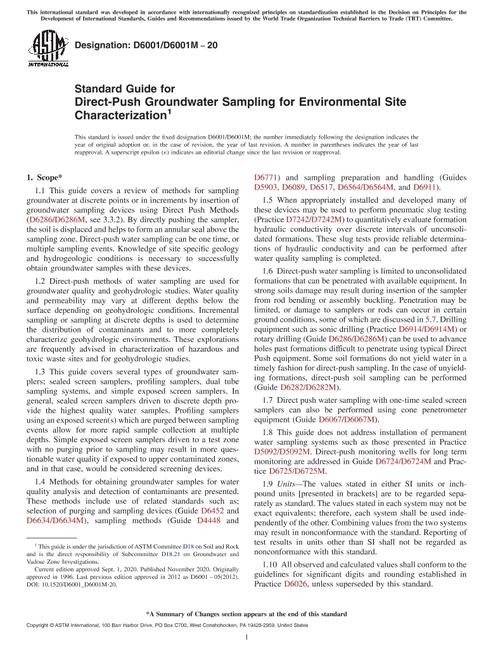
1.1 This guide covers a review of methods for sampling groundwater at discrete points or in increments by insertion of groundwater sampling devices using Direct Push Methods (D6286/D6286M, see 3.3.2). By directly pushing the sampler, the soil is displaced and helps to form an annular seal above the sampling zone. Direct-push water sampling can be one time, or multiple sampling events. Knowledge of site specific geology and hydrogeologic conditions is necessary to successfully obtain groundwater samples with these devices.
1.2 Direct-push methods of water sampling are used for groundwater quality and geohydrologic studies. Water quality and permeability may vary at different depths below the surface depending on geohydrologic conditions. Incremental sampling or sampling at discrete depths is used to determine the distribution of contaminants and to more completely characterize geohydrologic environments. These explorations are frequently advised in characterization of hazardous and toxic waste sites and for geohydrologic studies.
1.3 This guide covers several types of groundwater samplers; sealed screen samplers, profiling samplers, dual tube sampling systems, and simple exposed screen samplers. In general, sealed screen samplers driven to discrete depth provide the highest quality water samples. Profiling samplers using an exposed screen(s) which are purged between sampling events allow for more rapid sample collection at multiple depths. Simple exposed screen samplers driven to a test zone with no purging prior to sampling may result in more questionable water quality if exposed to upper contaminated zones, and in that case, would be considered screening devices.
1.4 Methods for obtaining groundwater samples for water quality analysis and detection of contaminants are presented. These methods include use of related standards such as; selection of purging and sampling devices (Guide D6452 and D6634/D6634M), sampling methods (Guide D4448 and D6771) and sampling preparation and handling (Guides D5903, D6089, D6517, D6564/D6564M, and D6911).
1.5 When appropriately installed and developed many of these devices may be used to perform pneumatic slug testing (Practice D7242/D7242M) to quantitatively evaluate formation hydraulic conductivity over discrete intervals of unconsolidated formations. These slug tests provide reliable determinations of hydraulic conductivity and can be performed after water quality sampling is completed.
1.6 Direct-push water sampling is limited to unconsolidated formations that can be penetrated with available equipment. In strong soils damage may result during insertion of the sampler from rod bending or assembly buckling. Penetration may be limited, or damage to samplers or rods can occur in certain ground conditions, some of which are discussed in 5.7. Drilling equipment such as sonic drilling (Practice D6914/D6914M) or rotary drilling (Guide D6286/D6286M) can be used to advance holes past formations difficult to penetrate using typical Direct Push equipment. Some soil formations do not yield water in a timely fashion for direct-push sampling. In the case of unyielding formations, direct-push soil sampling can be performed (Guide D6282/D6282M).
1.7 Direct push water sampling with one-time sealed screen samplers can also be performed using cone penetrometer equipment (Guide D6067/D6067M).
1.8 This guide does not address installation of permanent water sampling systems such as those presented in Practice D5092/D5092M. Direct-push monitoring wells for long term monitoring are addressed in Guide D6724/D6724M and Practice D6725/D6725M.
1.9 Units-The values stated in either SI units or inch-pound units [presented in brackets] are to be regarded separately as standard. The values stated in each system may not be exact equivalents; therefore, each system shall be used independently of the other. Combining values from the two systems may result in nonconformance with the standard. Reporting of test results in units other than SI shall not be regarded as nonconformance with this standard.
1.10 All observed and calculated values shall conform to the guidelines for significant digits and rounding established in Practice D6026, unless superseded by this standard.
1.11 This standard does not purport to address all of the safety concerns, if any, associated with its use. It is the responsibility of the user of this standard to establish appropriate safety, health, and environmental practices and determine the applicability of regulatory limitations prior to use.
1.12 This guide offers an organized collection of information or a series of options and does not recommend a specific course of action. This document cannot replace education or experience and should be used in conjunction with professional judgment. Not all aspects of this guide may be applicable in all circumstances. This ASTM standard is not intended to represent or replace the standard of care by which the adequacy of a given professional service must be judged, nor should this document be applied without consideration of a project's many unique aspects. The word “Standard” in the title of this document means only that the document has been approved through the ASTM consensus process.
1.13 This international standard was developed in accordance with internationally recognized principles on standardization established in the Decision on Principles for the Development of International Standards, Guides and Recommendations issued by the World Trade Organization Technical Barriers to Trade (TBT) Committee.
| File Size : | 1 file , 670 KB |
| Note : | This product is unavailable in Russia, Ukraine, Belarus |
| Number of Pages : | 22 |
| Published : | 09/01/2020 |
| Redline File Size : | 2 files , 1.5 MB |