Name:
ASTM D6235-18 PDF
Published Date:
12/15/2018
Status:
Active
Publisher:
ASTM International
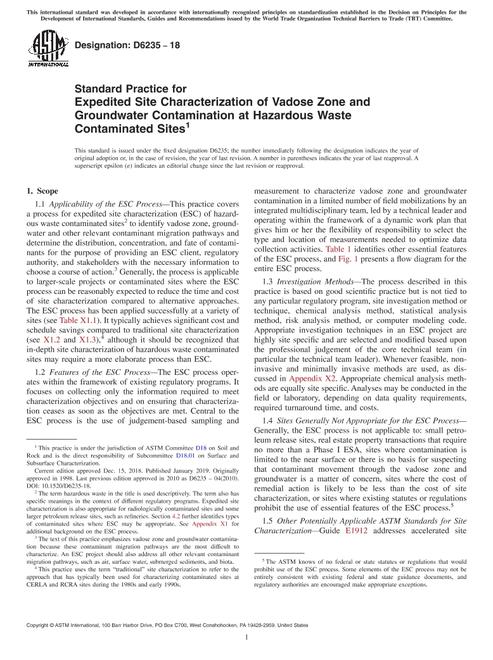
1.1 Applicability of the ESC Process-This practice covers a process for expedited site characterization (ESC) of hazardous waste contaminated sites2 to identify vadose zone, groundwater and other relevant contaminant migration pathways and determine the distribution, concentration, and fate of contaminants for the purpose of providing an ESC client, regulatory authority, and stakeholders with the necessary information to choose a course of action.3 Generally, the process is applicable to larger-scale projects or contaminated sites where the ESC process can be reasonably expected to reduce the time and cost of site characterization compared to alternative approaches. The ESC process has been applied successfully at a variety of sites (see Table X1.1). It typically achieves significant cost and schedule savings compared to traditional site characterization (see X1.2 and X1.3),4 although it should be recognized that in-depth site characterization of hazardous waste contaminated sites may require a more elaborate process than ESC.
1.2 Features of the ESC Process-The ESC process operates within the framework of existing regulatory programs. It focuses on collecting only the information required to meet characterization objectives and on ensuring that characterization ceases as soon as the objectives are met. Central to the ESC process is the use of judgement-based sampling and measurement to characterize vadose zone and groundwater contamination in a limited number of field mobilizations by an integrated multidisciplinary team, led by a technical leader and operating within the framework of a dynamic work plan that gives him or her the flexibility of responsibility to select the type and location of measurements needed to optimize data collection activities. Table 1 identifies other essential features of the ESC process, and Fig. 1 presents a flow diagram for the entire ESC process.
FIG. 1 Overview of the Expedited Site Characterization Process
1.3 Investigation Methods-The process described in this practice is based on good scientific practice but is not tied to any particular regulatory program, site investigation method or technique, chemical analysis method, statistical analysis method, risk analysis method, or computer modeling code. Appropriate investigation techniques in an ESC project are highly site specific and are selected and modified based upon the professional judgement of the core technical team (in particular the technical team leader). Whenever feasible, noninvasive and minimally invasive methods are used, as discussed in Appendix X2. Appropriate chemical analysis methods are equally site specific. Analyses may be conducted in the field or laboratory, depending on data quality requirements, required turnaround time, and costs.
1.4 Sites Generally Not Appropriate for the ESC Process-Generally, the ESC process is not applicable to: small petroleum release sites, real estate property transactions that require no more than a Phase I ESA, sites where contamination is limited to the near surface or there is no basis for suspecting that contaminant movement through the vadose zone and groundwater is a matter of concern, sites where the cost of remedial action is likely to be less than the cost of site characterization, or sites where existing statutes or regulations prohibit the use of essential features of the ESC process.5
1.5 Other Potentially Applicable ASTM Standards for Site Characterization-Guide E1912 addresses accelerated site characterization (ASC) for petroleum release sites, and Guide E1739 addresses use of the risk-based corrective action (RBCA) process at petroleum release sites. Section X1.5.1 describes the ASC process, and X1.5.2 discusses the relationship between ESC and the RBCA process. Practices E1527 and E1528 and Guide E1903 address real estate property transactions, and X1.5.3 discusses the relationship between the ESC process and investigations for real estate property transactions. Classification D5746 addresses environmental conditions of property area types for Department of Defense installations, and Practice D6008 provides guidance on conducting environmental baseline surveys to determine certain elements of the environmental condition of federal real property.
1.6 The values stated in both inch-pound and SI units are to be regarded separately as the standard. The values given in parentheses are for information only.
1.7 All references in this standard to the “engineer” must be understood as referring to a qualified professional (such as an engineer, soil scientist or geologist) who has the appropriate experience and, if required by local regulations, certification.
1.8 This practice offers an organized collection of information or a series of options and does not recommend a specific course of action. This document cannot replace education or experience and should be used in conjunction with professional judgment. Not all aspects of this practice may be applicable in all circumstances. This ASTM standard is not intended to represent or replace the standard of care by which the adequacy of a given professional service must be judged, nor should this document be applied without consideration of a project's many unique aspects. The word “Standard” in the title of this document means only that the document has been approved through the ASTM consensus process.
1.9 This standard does not purport to address all of the safety concerns, if any, associated with its use. It is the responsibility of the user of this standard to establish appropriate safety, health, and environmental practices and determine the applicability of regulatory limitations prior to use.
1.10 This international standard was developed in accordance with internationally recognized principles on standardization established in the Decision on Principles for the Development of International Standards, Guides and Recommendations issued by the World Trade Organization Technical Barriers to Trade (TBT) Committee.
| File Size : | 1 file , 2.5 MB |
| Note : | This product is unavailable in Russia, Ukraine, Belarus |
| Number of Pages : | 50 |
| Published : | 12/15/2018 |
| Redline File Size : | 2 files , 5.7 MB |