Name:
ASTM D6355-07(2012) PDF
Published Date:
12/01/2012
Status:
Active
Publisher:
ASTM International
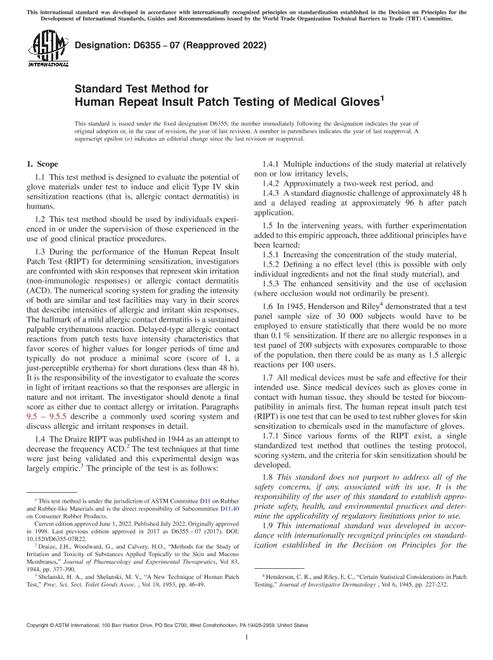
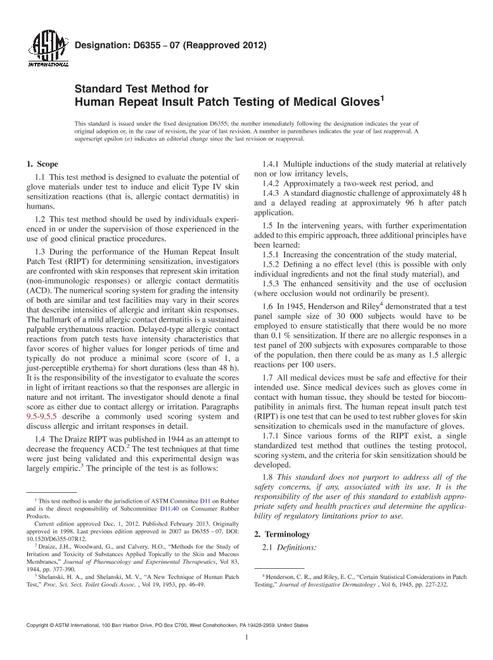
1.1 This test method is designed to evaluate the potential of glove materials under test to induce and elicit Type IV skin sensitization reactions (that is, allergic contact dermatitis) in humans.
1.2 This test method should be used by individuals experienced in or under the supervision of those experienced in the use of good clinical practice procedures.
1.3 During the performance of the Human Repeat Insult Patch Test (RIPT) for determining sensitization, investigators are confronted with skin responses that represent skin irritation (non-immunologic responses) or allergic contact dermatitis (ACD). The numerical scoring system for grading the intensity of both are similar and test facilities may vary in their scores that describe intensities of allergic and irritant skin responses. The hallmark of a mild allergic contact dermatitis is a sustained palpable erythematous reaction. Delayed-type allergic contact reactions from patch tests have intensity characteristics that favor scores of higher values for longer periods of time and typically do not produce a minimal score (score of 1, a just-perceptible erythema) for short durations (less than 48 h). It is the responsibility of the investigator to evaluate the scores in light of irritant reactions so that the responses are allergic in nature and not irritant. The investigator should denote a final score as either due to contact allergy or irritation. Paragraphs 9.5-9.5.5 describe a commonly used scoring system and discuss allergic and irritant responses in detail.
1.4 The Draize RIPT was published in 1944 as an attempt to decrease the frequency ACD.2 The test techniques at that time were just being validated and this experimental design was largely empiric.3 The principle of the test is as follows:
1.4.1 Multiple inductions of the study material at relatively non or low irritancy levels,
1.4.2 Approximately a two-week rest period, and
1.4.3 A standard diagnostic challenge of approximately 48 h and a delayed reading at approximately 96 h after patch application.
1.5 In the intervening years, with further experimentation added to this empiric approach, three additional principles have been learned:
1.5.1 Increasing the concentration of the study material,
1.5.2 Defining a no effect level (this is possible with only individual ingredients and not the final study material), and
1.5.3 The enhanced sensitivity and the use of occlusion (where occlusion would not ordinarily be present).
1.6 In 1945, Henderson and Riley4 demonstrated that a test panel sample size of 30 000 subjects would have to be employed to ensure statistically that there would be no more than 0.1 % sensitization. If there are no allergic responses in a test panel of 200 subjects with exposures comparable to those of the population, then there could be as many as 1.5 allergic reactions per 100 users.
1.7 All medical devices must be safe and effective for their intended use. Since medical devices such as gloves come in contact with human tissue, they should be tested for biocompatibility in animals first. The human repeat insult patch test (RIPT) is one test that can be used to test rubber gloves for skin sensitization to chemicals used in the manufacture of gloves.
1.7.1 Since various forms of the RIPT exist, a single standardized test method that outlines the testing protocol, scoring system, and the criteria for skin sensitization should be developed.
1.8 This standard does not purport to address all of the safety concerns, if any, associated with its use. It is the responsibility of the user of this standard to establish appropriate safety and health practices and determine the applicability of regulatory limitations prior to use.
| File Size : | 1 file , 86 KB |
| Note : | This product is unavailable in Russia, Ukraine, Belarus |
| Number of Pages : | 7 |
| Published : | 12/01/2012 |