Name:
ASTM D6391-06 PDF
Published Date:
02/01/2006
Status:
Active
Publisher:
ASTM International
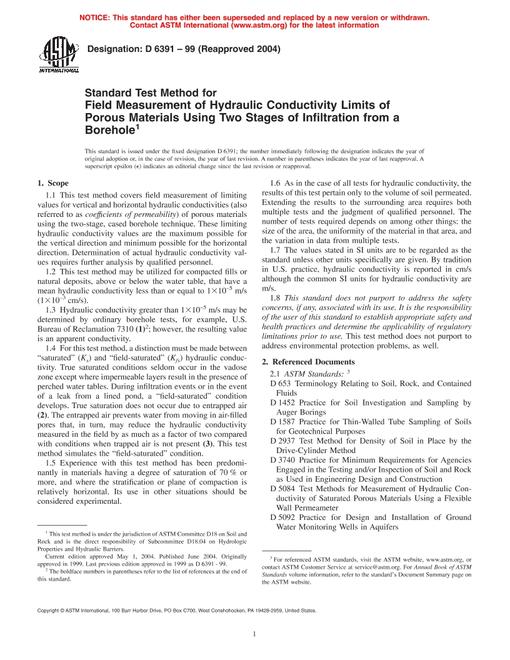
1.1 This test method covers field measurement of limiting values for vertical and horizontal hydraulic conductivities (also referred to as coefficients of permeability) of porous materials using the two-stage, cased borehole technique. These limiting hydraulic conductivity values are the maximum possible for the vertical direction and minimum possible for the horizontal direction. Determination of actual hydraulic conductivity values requires further analysis by qualified personnel.
1.2 This test method may be utilized for compacted fills or natural deposits, above or below the water table, that have a mean hydraulic conductivity less than or equal to 110-5 m/s (110-3 cm/s).
1.3 Hydraulic conductivity greater than 110 -5 m/s may be determined by ordinary borehole tests, for example, U.S. Bureau of Reclamation 7310 (); however, the resulting value is an apparent conductivity.
1.4 For this test method, a distinction must be made between "saturated" (Ks) and "field-saturated" (Kfs) hydraulic conductivity. True saturated conditions seldom occur in the vadose zone except where impermeable layers result in the presence of perched water tables. During infiltration events or in the event of a leak from a lined pond, a "field-saturated" condition develops. True saturation does not occur due to entrapped air (). The entrapped air prevents water from moving in air-filled pores that, in turn, may reduce the hydraulic conductivity measured in the field by as much as a factor of two compared with conditions when trapped air is not present (). This test method simulates the "field-saturated" condition.
1.5 Experience with this test method has been predominantly in materials having a degree of saturation of 70 % or more, and where the stratification or plane of compaction is relatively horizontal. Its use in other situations should be considered experimental.
1.6 As in the case of all tests for hydraulic conductivity, the results of this test pertain only to the volume of soil permeated. Extending the results to the surrounding area requires both multiple tests and the judgment of qualified personnel. The number of tests required depends on among other things: the size of the area, the uniformity of the material in that area, and the variation in data from multiple tests.
1.7 The values stated in SI units are to be regarded as the standard unless other units specifically are given. By tradition in U.S. practice, hydraulic conductivity is reported in cm/s although the common SI units for hydraulic conductivity are m/s.
1.8 All observed and calculated values shall conform to the guide for significant digits and rounding established in Practice D 6026.
1.8.1 The procedures in this standard that are used to specify how data are collected, recorded, and calculated are regarded as the industry standard. In addition, they are representative of the significant digits that should generally be retained. The procedures do not consider material variation, purpose for obtaining the data, special purpose studies, or any considerations for the objectives of the user. Increasing or reducing the significant digits of reported data to be commensurate with these considerations is common practice. Consideration of the significant digits to be used in analysis methods for engineering design is beyond the scope of this standard.
1.9 This standard does not purport to address the safety concerns, if any, associated with its use. It is the responsibility of the user of this standard to establish appropriate safety and health practices and determine the applicability of regulatory limitations prior to use. This test method does not purport to address environmental protection problems, as well.
| File Size : | 1 file , 250 KB |
| Note : | This product is unavailable in Russia, Ukraine, Belarus |
| Number of Pages : | 12 |
| Published : | 02/01/2006 |
| Redline File Size : | 2 files , 470 KB |