Name:
ASTM D6431-18 PDF
Published Date:
02/01/2018
Status:
Active
Publisher:
ASTM International
1.1 Purpose and Application:
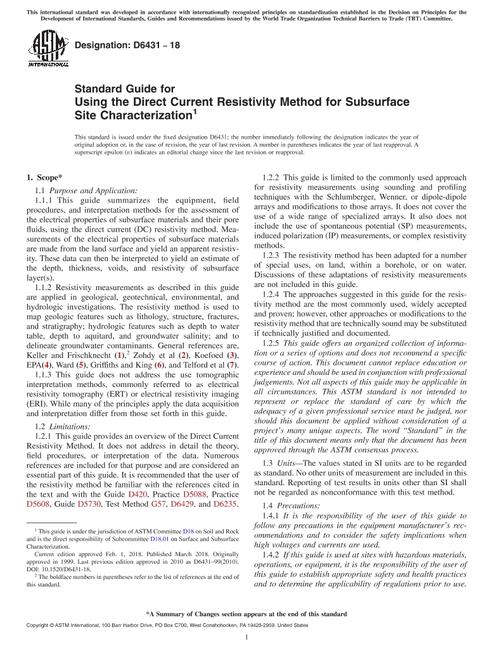
1.1.1 This guide summarizes the equipment, field procedures, and interpretation methods for the assessment of the electrical properties of subsurface materials and their pore fluids, using the direct current (DC) resistivity method. Measurements of the electrical properties of subsurface materials are made from the land surface and yield an apparent resistivity. These data can then be interpreted to yield an estimate of the depth, thickness, voids, and resistivity of subsurface layer(s).
1.1.2 Resistivity measurements as described in this guide are applied in geological, geotechnical, environmental, and hydrologic investigations. The resistivity method is used to map geologic features such as lithology, structure, fractures, and stratigraphy; hydrologic features such as depth to water table, depth to aquitard, and groundwater salinity; and to delineate groundwater contaminants. General references are, Keller and Frischknecht (1),2 Zohdy et al (2), Koefoed (3), EPA(4), Ward (5), Griffiths and King (6), and Telford et al (7).
1.1.3 This guide does not address the use tomographic interpretation methods, commonly referred to as electrical resistivity tomography (ERT) or electrical resistivity imaging (ERI). While many of the principles apply the data acquisition and interpretation differ from those set forth in this guide.
1.2 Limitations:
1.2.1 This guide provides an overview of the Direct Current Resistivity Method. It does not address in detail the theory, field procedures, or interpretation of the data. Numerous references are included for that purpose and are considered an essential part of this guide. It is recommended that the user of the resistivity method be familiar with the references cited in the text and with the Guide D420, Practice D5088, Practice D5608, Guide D5730, Test Method G57, D6429, and D6235.
1.2.2 This guide is limited to the commonly used approach for resistivity measurements using sounding and profiling techniques with the Schlumberger, Wenner, or dipole-dipole arrays and modifications to those arrays. It does not cover the use of a wide range of specialized arrays. It also does not include the use of spontaneous potential (SP) measurements, induced polarization (IP) measurements, or complex resistivity methods.
1.2.3 The resistivity method has been adapted for a number of special uses, on land, within a borehole, or on water. Discussions of these adaptations of resistivity measurements are not included in this guide.
1.2.4 The approaches suggested in this guide for the resistivity method are the most commonly used, widely accepted and proven; however, other approaches or modifications to the resistivity method that are technically sound may be substituted if technically justified and documented.
1.2.5 This guide offers an organized collection of information or a series of options and does not recommend a specific course of action. This document cannot replace education or experience and should be used in conjunction with professional judgements. Not all aspects of this guide may be applicable in all circumstances. This ASTM standard is not intended to represent or replace the standard of care by which the adequacy of a given professional service must be judged, nor should this document be applied without consideration of a project's many unique aspects. The word “Standard” in the title of this document means only that the document has been approved through the ASTM consensus process.
1.3 Units-The values stated in SI units are to be regarded as standard. No other units of measurement are included in this standard. Reporting of test results in units other than SI shall not be regarded as nonconformance with this test method.
1.4 Precautions:
1.4.1 It is the responsibility of the user of this guide to follow any precautions in the equipment manufacturer's recommendations and to consider the safety implications when high voltages and currents are used.
1.4.2 If this guide is used at sites with hazardous materials, operations, or equipment, it is the responsibility of the user of this guide to establish appropriate safety and health practices and to determine the applicability of regulations prior to use.
1.5 This standard does not purport to address all of the safety concerns, if any, associated with its use. It is the responsibility of the user of this standard to establish appropriate safety, health, and environmental practices and determine the applicability of regulatory limitations prior to use.
1.6 This international standard was developed in accordance with internationally recognized principles on standardization established in the Decision on Principles for the Development of International Standards, Guides and Recommendations issued by the World Trade Organization Technical Barriers to Trade (TBT) Committee.
| File Size : | 1 file , 580 KB |
| Note : | This product is unavailable in Russia, Ukraine, Belarus |
| Number of Pages : | 14 |
| Published : | 02/01/2018 |
| Redline File Size : | 2 files , 1.3 MB |