Name:
ASTM D6954-04(2013) PDF
Published Date:
01/01/2013
Status:
Active
Publisher:
ASTM International
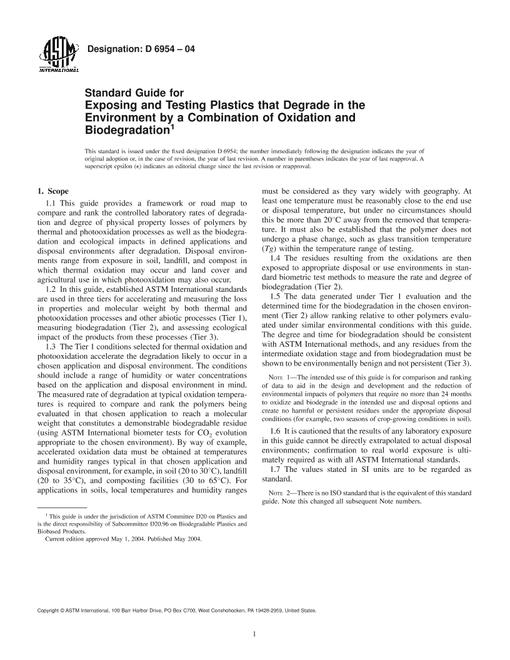
1.1 This guide provides a framework or road map to compare and rank the controlled laboratory rates of degradation and degree of physical property losses of polymers by thermal and photooxidation processes as well as the biodegradation and ecological impacts in defined applications and disposal environments after degradation. Disposal environments range from exposure in soil, landfill, and compost in which thermal oxidation may occur and land cover and agricultural use in which photooxidation may also occur.
1.2 In this guide, established ASTM International standards are used in three tiers for accelerating and measuring the loss in properties and molecular weight by both thermal and photooxidation processes and other abiotic processes (Tier 1), measuring biodegradation (Tier 2), and assessing ecological impact of the products from these processes (Tier 3).
1.3 The Tier 1 conditions selected for thermal oxidation and photooxidation accelerate the degradation likely to occur in a chosen application and disposal environment. The conditions should include a range of humidity or water concentrations based on the application and disposal environment in mind. The measured rate of degradation at typical oxidation temperatures is required to compare and rank the polymers being evaluated in that chosen application to reach a molecular weight that constitutes a demonstrable biodegradable residue (using ASTM International biometer tests for CO2 evolution appropriate to the chosen environment). By way of example, accelerated oxidation data must be obtained at temperatures and humidity ranges typical in that chosen application and disposal environment, for example, in soil (20 to 30??C), landfill (20 to 35??C), and composting facilities (30 to 65??C). For applications in soils, local temperatures and humidity ranges must be considered as they vary widely with geography. At least one temperature must be reasonably close to the end use or disposal temperature, but under no circumstances should this be more than 20??C away from the removed that temperature. It must also be established that the polymer does not undergo a phase change, such as glass transition temperature (Tg) within the temperature range of testing.
1.4 The residues resulting from the oxidations are then exposed to appropriate disposal or use environments in standard biometric test methods to measure the rate and degree of biodegradation (Tier 2).
1.5 The data generated under Tier 1 evaluation and the determined time for the biodegradation in the chosen environment (Tier 2) allow ranking relative to other polymers evaluated under similar environmental conditions with this guide. The degree and time for biodegradation should be consistent with ASTM International methods, and any residues from the intermediate oxidation stage and from biodegradation must be shown to be environmentally benign and not persistent (Tier 3).
Note 1???The intended use of this guide is for comparison and ranking of data to aid in the design and development and the reduction of environmental impacts of polymers that require no more than 24 months to oxidize and biodegrade in the intended use and disposal options and create no harmful or persistent residues under the appropriate disposal conditions (for example, two seasons of crop-growing conditions in soil).1.6 It is cautioned that the results of any laboratory exposure in this guide cannot be directly extrapolated to actual disposal environments; confirmation to real world exposure is ultimately required as with all ASTM International standards.
1.7 The values stated in SI units are to be regarded as standard.
Note 2???There is no ISO standard that is the equivalent of this standard guide. Note this changed all subsequent Note numbers.1.8 This standard does not purport to address all of the safety concerns, if any, associated with its use. It is the responsibility of the user of this standard to establish appropriate safety and health practices and determine the applicability of regulatory requirements prior to use.
| File Size : | 1 file , 110 KB |
| Note : | This product is unavailable in Russia, Ukraine, Belarus |
| Number of Pages : | 6 |
| Published : | 01/01/2013 |