Name:
ASTM D7155-20 PDF
Published Date:
05/01/2020
Status:
Active
Publisher:
ASTM International
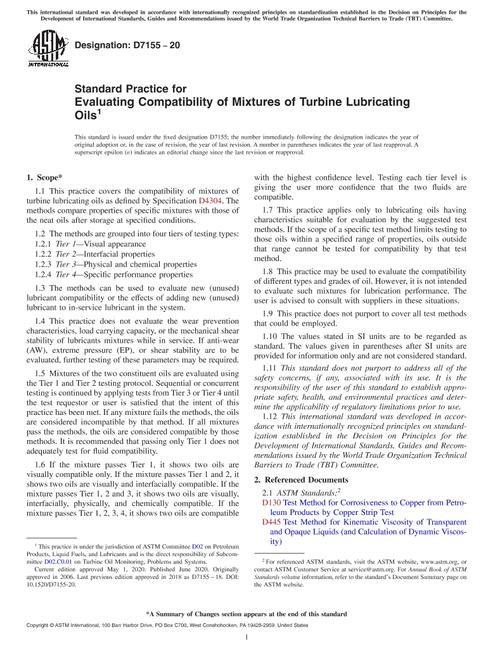
1.1 This practice covers the compatibility of mixtures of turbine lubricating oils as defined by Specification D4304. The methods compare properties of specific mixtures with those of the neat oils after storage at specified conditions.
1.2 The methods are grouped into four tiers of testing types:
1.2.1 Tier 1-Visual appearance
1.2.2 Tier 2-Interfacial properties
1.2.3 Tier 3-Physical and chemical properties
1.2.4 Tier 4-Specific performance properties
1.3 The methods can be used to evaluate new (unused) lubricant compatibility or the effects of adding new (unused) lubricant to in-service lubricant in the system.
1.4 This practice does not evaluate the wear prevention characteristics, load carrying capacity, or the mechanical shear stability of lubricants mixtures while in service. If anti-wear (AW), extreme pressure (EP), or shear stability are to be evaluated, further testing of these parameters may be required.
1.5 Mixtures of the two constituent oils are evaluated using the Tier 1 and Tier 2 testing protocol. Sequential or concurrent testing is continued by applying tests from Tier 3 or Tier 4 until the test requestor or user is satisfied that the intent of this practice has been met. If any mixture fails the methods, the oils are considered incompatible by that method. If all mixtures pass the methods, the oils are considered compatible by those methods. It is recommended that passing only Tier 1 does not adequately test for fluid compatibility.
1.6 If the mixture passes Tier 1, it shows two oils are visually compatible only. If the mixture passes Tier 1 and 2, it shows two oils are visually and interfacially compatible. If the mixture passes Tier 1, 2 and 3, it shows two oils are visually, interfacially, physically, and chemically compatible. If the mixture passes Tier 1, 2, 3, 4, it shows two oils are compatible with the highest confidence level. Testing each tier level is giving the user more confidence that the two fluids are compatible.
1.7 This practice applies only to lubricating oils having characteristics suitable for evaluation by the suggested test methods. If the scope of a specific test method limits testing to those oils within a specified range of properties, oils outside that range cannot be tested for compatibility by that test method.
1.8 This practice may be used to evaluate the compatibility of different types and grades of oil. However, it is not intended to evaluate such mixtures for lubrication performance. The user is advised to consult with suppliers in these situations.
1.9 This practice does not purport to cover all test methods that could be employed.
1.10 The values stated in SI units are to be regarded as standard. The values given in parentheses after SI units are provided for information only and are not considered standard.
1.11 This standard does not purport to address all of the safety concerns, if any, associated with its use. It is the responsibility of the user of this standard to establish appropriate safety, health, and environmental practices and determine the applicability of regulatory limitations prior to use.
1.12 This international standard was developed in accordance with internationally recognized principles on standardization established in the Decision on Principles for the Development of International Standards, Guides and Recommendations issued by the World Trade Organization Technical Barriers to Trade (TBT) Committee.
| File Size : | 1 file , 200 KB |
| Note : | This product is unavailable in Russia, Ukraine, Belarus |
| Number of Pages : | 10 |
| Published : | 05/01/2020 |
| Redline File Size : | 2 files , 420 KB |