Name:
ASTM D832-07(2012) PDF
Published Date:
12/01/2012
Status:
Active
Publisher:
ASTM International
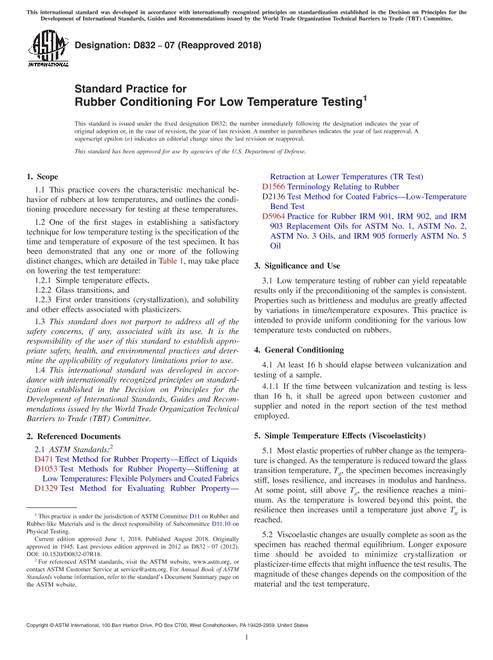
1.2 One of the first stages in establishing a satisfactory technique for low temperature testing is the specification of the time and temperature of exposure of the test specimen. It has been demonstrated that any one or more of the following distinct changes, which are detailed in Table 1, may take place on lowering the test temperature:
| Property | Crystallization | Glass Transition |
| Physical effects | Becomes stiff (hard) but not necessarily brittle | Becomes stiff and brittle |
| Temperature-volume relation | Significant decrease in volume | No change in volume, but definite change in coefficient of thermal expansion |
| Latent heat effect (4, 5, 8) | Heat evolved on crystallization | Usually no heat effect, but definite change in specific heat |
| Rate (2, 4, 6, 7, 8) | Minutes, hours, days, or even months may be required. In general, as temperature is lowered, rate increases to a maximum and then decreases with increase in deformation. Rate also varies with composition, state of cure, and nuclei remaining from previous crystallizations, or from compounding materials such as carbon black. | Usually rapid; takes place within a definite narrow temperature range regardless of thermal history of specimen. May be limited rate effect (2) |
| Temperature of occurrence | Optimum temperature is specific to the polymer involved. | Very wide limits, depending on composition |
| Effect on molecular structure | Orientation of molecular segments; random if unstrained, approaching parrallelism under strain | Change in type of motion of segments of molecule |
| Materials exhibiting | Unstretched polymers including natural rubber (low sulfur vulcanizates), chloroprene, Thiokol A polysulfide rubber, butadiene copolymers with high butadiene content, most silicones, some polyurethanes. Butyl rubbers crystallize when strained. Straining increases rate of crystallization of all of the above materials. | All |
1.3 This standard does not purport to address all of the safety concerns, if any, associated with its use. It is the responsibility of the user of this standard to establish appropriate safety and health practices and determine the applicability of regulatory limitations prior to use.
| File Size : | 1 file , 74 KB |
| Note : | This product is unavailable in Russia, Ukraine, Belarus |
| Number of Pages : | 4 |
| Published : | 12/01/2012 |