Name:
ASTM D94-07(2012) PDF
Published Date:
11/01/2012
Status:
Active
Publisher:
ASTM International
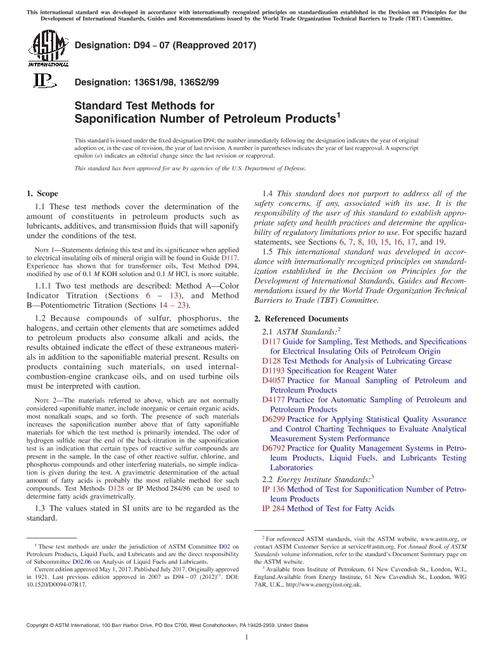
1.1 These test methods cover the determination of the amount of constituents in petroleum products such as lubricants, additives, and transmission fluids that will saponify under the conditions of the test.
Note 1???Statements defining this test and its significance when applied to electrical insulating oils of mineral origin will be found in Guide D117. Experience has shown that for transformer oils, Test Method D94, modified by use of 0.1 M KOH solution and 0.1 M HCl, is more suitable.1.1.1 Two test methods are described: Method A???Color Indicator Titration (Sections 6-13), and Method B???Potentiometric Titration (Sections 14-23).
1.2 Because compounds of sulfur, phosphorus, the halogens, and certain other elements that are sometimes added to petroleum products also consume alkali and acids, the results obtained indicate the effect of these extraneous materials in addition to the saponifiable material present. Results on products containing such materials, on used internal-combustion-engine crankcase oils, and on used turbine oils must be interpreted with caution.
Note 2???The materials referred to above, which are not normally considered saponifiable matter, include inorganic or certain organic acids, most nonalkali soaps, and so forth. The presence of such materials increases the saponification number above that of fatty saponifiable materials for which the test method is primarily intended. The odor of hydrogen sulfide near the end of the back-titration in the saponification test is an indication that certain types of reactive sulfur compounds are present in the sample. In the case of other reactive sulfur, chlorine, and phosphorus compounds and other interfering materials, no simple indication is given during the test. A gravimetric determination of the actual amount of fatty acids is probably the most reliable method for such compounds. Test Methods D128 or IP Method 284/86 can be used to determine fatty acids gravimetrically.1.3 The values stated in SI units are to be regarded as the standard.
1.4 This standard does not purport to address all of the safety concerns, if any, associated with its use. It is the responsibility of the user of this standard to establish appropriate safety and health practices and determine the applicability of regulatory limitations prior to use. For specific hazard statements, see Sections 6, 7, 8, 10, 15, 16, 17, and 19.
| File Size : | 1 file , 160 KB |
| Note : | This product is unavailable in Russia, Ukraine, Belarus |
| Number of Pages : | 9 |
| Published : | 11/01/2012 |