Name:
ASTM E1023-84(2014) PDF
Published Date:
10/01/2014
Status:
Active
Publisher:
ASTM International
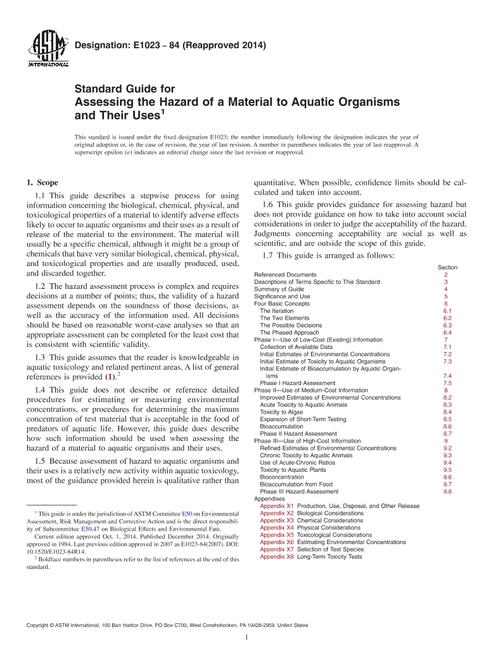
1.1 This guide describes a stepwise process for using information concerning the biological, chemical, physical, and toxicological properties of a material to identify adverse effects likely to occur to aquatic organisms and their uses as a result of release of the material to the environment. The material will usually be a specific chemical, although it might be a group of chemicals that have very similar biological, chemical, physical, and toxicological properties and are usually produced, used, and discarded together.
1.2 The hazard assessment process is complex and requires decisions at a number of points; thus, the validity of a hazard assessment depends on the soundness of those decisions, as well as the accuracy of the information used. All decisions should be based on reasonable worst-case analyses so that an appropriate assessment can be completed for the least cost that is consistent with scientific validity.
1.3 This guide assumes that the reader is knowledgeable in aquatic toxicology and related pertinent areas. A list of general references is provided (1).2
1.4 This guide does not describe or reference detailed procedures for estimating or measuring environmental concentrations, or procedures for determining the maximum concentration of test material that is acceptable in the food of predators of aquatic life. However, this guide does describe how such information should be used when assessing the hazard of a material to aquatic organisms and their uses.
1.5 Because assessment of hazard to aquatic organisms and their uses is a relatively new activity within aquatic toxicology, most of the guidance provided herein is qualitative rather than quantitative. When possible, confidence limits should be calculated and taken into account.
1.6 This guide provides guidance for assessing hazard but does not provide guidance on how to take into account social considerations in order to judge the acceptability of the hazard. Judgments concerning acceptability are social as well as scientific, and are outside the scope of this guide.
1.7 This guide is arranged as follows:
Section
Referenced Documents
2
Descriptions of Terms Specific to This Standard
3
Summary of Guide
4
Significance and Use
5
Four Basic Concepts
6
The Iteration
6.1
The Two Elements
6.2
The Possible Decisions
6.3
The Phased Approach
6.4
Phase I-Use of Low-Cost (Existing) Information
7
Collection of Available Data
7.1
Initial Estimates of Environmental Concentrations
7.2
Initial Estimate of Toxicity to Aquatic Organisms
7.3
Initial Estimate of Bioaccumulation by Aquatic Organ-
isms
7.4
Phase I Hazard Assessment
7.5
Phase II-Use of Medium-Cost Information
8
Improved Estimates of Environmental Concentrations
8.2
Acute Toxicity to Aquatic Animals
8.3
Toxicity to Algae
8.4
Expansion of Short-Term Testing
8.5
Bioaccumulation
8.6
Phase II Hazard Assessment
8.7
Phase III-Use of High-Cost Information
9
Refined Estimates of Environmental Concentrations
9.2
Chronic Toxicity to Aquatic Animals
9.3
Use of Acute-Chronic Ratios
9.4
Toxicity to Aquatic Plants
9.5
Bioconcentration
9.6
Bioaccumulation from Food
9.7
Phase III Hazard Assessment
9.8
Appendixes
Appendix X1 Production, Use, Disposal, and Other Release
Appendix X2 Biological Considerations
Appendix X3 Chemical Considerations
Appendix X4 Physical Considerations
Appendix X5 Toxicological Considerations
Appendix X6 Estimating Environmental Concentrations
Appendix X7 Selection of Test Species
Appendix X8 Long-Term Toxicity Tests
1.8 This standard does not purport to address all of the safety concerns, if any, associated with its use. It is the responsibility of the user of this standard to establish appropriate safety and health practices and determine the applicability of regulatory limitations prior to use.
| File Size : | 1 file , 220 KB |
| Note : | This product is unavailable in Russia, Ukraine, Belarus |
| Number of Pages : | 18 |
| Published : | 10/01/2014 |