Name:
ASTM E1530-99 PDF
Published Date:
03/10/1999
Status:
Active
Publisher:
ASTM International
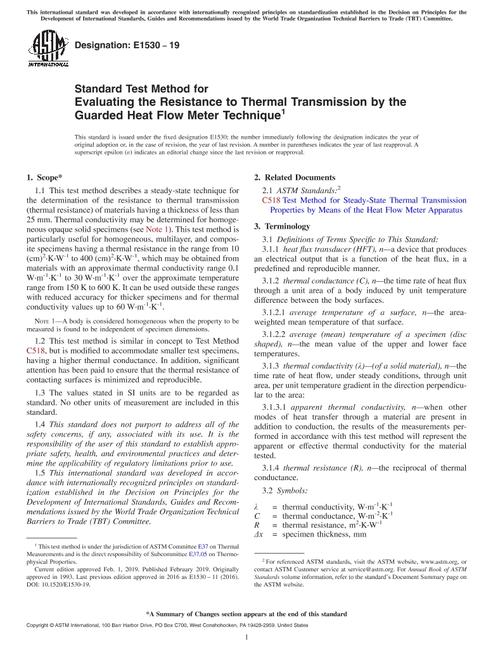
1.1 This test method covers a steady-state technique for the determination of the resistance to thermal transmission (thermal resistance) of thin specimens of materials and composites, especially in thicknesses of less than 12 mm. If the single or stacked thin specimens are homogeneous opaque solids and a representative thickness is used then thermal conductivity can be determined (see Notes 1 and 2). This test method is especially useful for materials in sheet and similar forms having a thermal resistance in the range from 20 to 400 X 10 -4 m2 K/W (an effective thermal conductivity in the approximate range 0.1 ∧ [lambda] ∧ 5 W/m[dot]K) over the approximate temperature range from 150 to 600 K. It can be used outside these ranges with reduced accuracy for thicker specimens and for thermal conductivities up to 10 W/m[dot]K.
Note 1-A body is considered homogeneous when the above property is found by measurement to be independent of specimen dimensions. Note 2-This test method may also be used to evaluate the thermal conductance/resistance of materials in contact, such as gaskets, and thermal conductance of gasket materials under actual high-loading conditions of a particular application.1.2 This test method is similar in concept to Test Method C518 but is modified to accommodate smaller test specimens having a higher thermal conductance. In addition, significant attention has been paid to ensure that the thermal resistance of contacting surfaces are minimized and reproducible such that instrumentation of calibration and test specimens with temperature sensors is unnecessary. There are cases, such as Practice F433, where the method is used with instrumentation of the reference specimen and utilization of an analog calculator. General information on improvements in this latter technique and on the modified calculation procedures are given in two appendices.
1.3 The values stated in SI units are to be regarded as the standard.
1.4 This standard does not purport to address all of the safety problems, if any, associated with its use. It is the responsibility of the user of this standard to establish appropriate safety and health practices and determine the applicability of regulatory limitations prior to use.
| File Size : | 1 file , 87 KB |
| Note : | This product is unavailable in Russia, Ukraine, Belarus |
| Number of Pages : | 7 |
| Published : | 03/10/1999 |