Name:
ASTM E1611-21 PDF
Published Date:
11/01/2021
Status:
Active
Publisher:
ASTM International
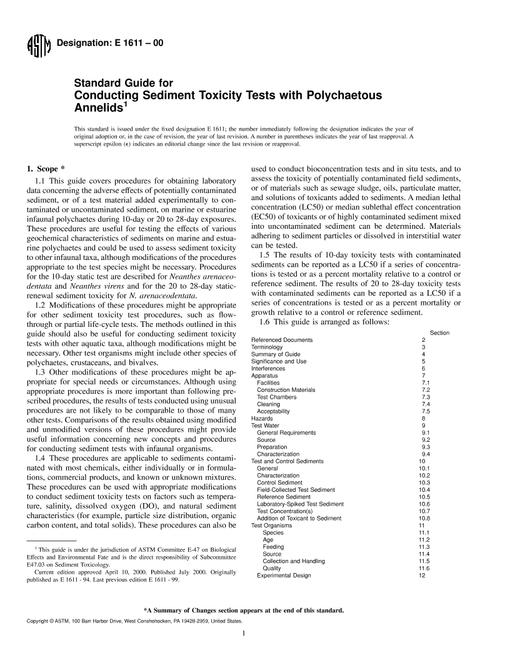
1.1''This guide covers procedures for obtaining laboratory data concerning the adverse effects of potentially contaminated sediment, or of a test material added experimentally to contaminated or uncontaminated sediment, on marine or estuarine infaunal polychaetes during 10-day or 20 to 28-day exposures. These procedures are useful for testing the effects of various geochemical characteristics of sediments on marine and estuarine polychaetes and could be used to assess sediment toxicity to other infaunal taxa, although modifications of the procedures appropriate to the test species might be necessary. Procedures for the 10-day static test are described for Neanthes arenaceodentata and Alitta virens 2 (formerly Nereis virens and Neanthes virens) and for the 20 to 28-day static-renewal sediment toxicity for N. arenaceodentata.
1.2''Modifications of these procedures might be appropriate for other sediment toxicity test procedures, such as flow-through or partial life-cycle tests. The methods outlined in this guide should also be useful for conducting sediment toxicity tests with other aquatic taxa, although modifications might be necessary. Other test organisms might include other species of polychaetes, crustaceans, and bivalves.
1.3''Other modifications of these procedures might be appropriate for special needs or circumstances. Although using appropriate procedures is more important than following prescribed procedures, the results of tests conducted using unusual procedures are not likely to be comparable to those of many other tests. Comparisons of the results obtained using modified and unmodified versions of these procedures might provide useful information concerning new concepts and procedures for conducting sediment tests with infaunal organisms.
1.4''These procedures are applicable to sediments contaminated with most chemicals, either individually or in formulations, commercial products, and known or unknown mixtures. These procedures can be used with appropriate modifications to conduct sediment toxicity tests on factors such as temperature, salinity, dissolved oxygen (DO), and natural sediment characteristics (for example, particle size distribution, organic carbon content, and total solids). These procedures can also be used to conduct bioconcentration tests and in situ tests, and to assess the toxicity of potentially contaminated field sediments, or of materials such as sewage sludge, oils, particulate matter, and solutions of toxicants added to sediments. A median lethal concentration (LC50) or median sublethal effect concentration (EC50) of toxicants or of highly contaminated sediment mixed into uncontaminated sediment can be determined. Materials adhering to sediment particles or dissolved in interstitial water can be tested.
1.5''The results of 10-day toxicity tests with contaminated sediments can be reported as a LC50 if a series of concentrations is tested or as a percent mortality relative to a control or reference sediment. The results of 20 to 28-day toxicity tests with contaminated sediments can be reported as a LC50 if a series of concentrations is tested or as a percent mortality or growth relative to a control or reference sediment.
1.6''This guide is arranged as follows:
''
Section
Referenced Documents
'''2
Terminology
'''3
Summary of Guide
'''4
Significance and Use
'''5
Interferences
'''6
Apparatus
'''7
'''Facilities
'''7.1
'''Construction Materials
'''7.2
'''Test Chambers
'''7.3
'''Cleaning
'''7.4
'''Acceptability
'''7.5
Hazards
'''8
Test Water
'''9
'''General Requirements
'''9.1
'''Source
'''9.2
'''Preparation
'''9.3
'''Characterization
'''9.4
Test and Control Sediments
10
'''General
10.1
'''Characterization
10.2
'''Control Sediment
10.3
'''Field-Collected Test Sediment
10.4
'''Reference Sediment
10.5
'''Laboratory-Spiked Test Sediment
10.6
'''Test Concentration(s)
10.7
'''Addition of Toxicant to Sediment
10.8
Test Organisms
11
''''''Species
11.1
''''''Age
11.2
''''''Feeding
11.3
''''''Source
11.4
''''''Collection and Handling
11.5
''''''Quality
11.6
'''Experimental Design
12
''''''Controls
12.2
''''''Field Survey Design
12.3
''''''Laboratory Experiments
12.4
'''Procedure
13
''''''Dissolved Oxygen
13.1
''''''Temperature
13.2
''''''Salinity
13.3
''''''Light
13.4
''''''Feeding
13.5
''''''Beginning of Test
13.6
''''''Duration of Test
13.7
''''''Biological Data
13.8
''''''Other Measurements
13.9
'''Analytical Methodology
14
'''Acceptability of Test
15
'''Interpretation of Results
16
'''Report
17
'''Keywords
18
'''Annexes
''
''''''Neanthes arenaceodentata
Annex A1
''''''Alitta virens
Annex A2
1.7''The values stated in SI units are to be regarded as standard. No other units of measurement are included in this standard.
1.8''This standard does not purport to address all of the safety concerns, if any, associated with its use. It is the responsibility of the user of this standard to establish appropriate safety, health, and environmental practices and determine the applicability of regulatory limitations prior to use. Specific hazards statements are given in Section 8.
1.9''This international standard was developed in accordance with internationally recognized principles on standardization established in the Decision on Principles for the Development of International Standards, Guides and Recommendations issued by the World Trade Organization Technical Barriers to Trade (TBT) Committee.
| File Size : | 1 file , 580 KB |
| Note : | This product is unavailable in Russia, Ukraine, Belarus |
| Number of Pages : | 28 |
| Published : | 11/01/2021 |
| Redline File Size : | 2 files , 1.3 MB |