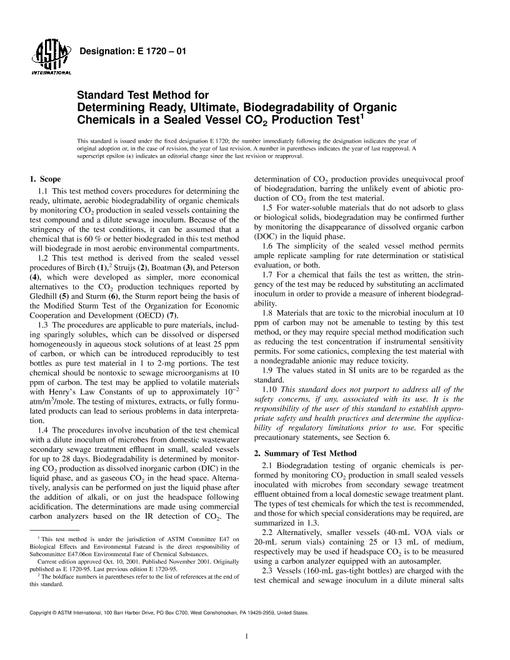
.1 This test method covers procedures for determining the ready, ultimate, aerobic biodegradability of organic chemicals by monitoring CO2 production in sealed vessels containing the test compound and a dilute sewage inoculum. Because of the stringency of the test conditions, it can be assumed that a chemical that is 60 % or better biodegraded in this test method will biodegrade in most aerobic environmental compartments.
1.2 This test method is derived from the sealed vessel procedures of Birch (1), Struijs (2), Boatman (3), and Peterson (4), which were developed as simpler, more economical alternatives to the CO2 production techniques reported by Gledhill (5) and Sturm (6), the Sturm report being the basis of the Modified Sturm Test of the Organization for Economic Cooperation and Development (OECD) (7).
1.3 The procedures are applicable to pure materials, including sparingly solubles, which can be dissolved or dispersed homogeneously in aqueous stock solutions of at least 25 ppm of carbon, or which can be introduced reproducibly to test bottles as pure test material in 1 to 2-mg portions. The test chemical should be nontoxic to sewage microorganisms at 10 ppm of carbon. The test may be applied to volatile materials with Henry's Law Constants of up to approximately 10-2 atm/m3/mole. The testing of mixtures, extracts, or fully formulated products can lead to serious problems in data interpretation.
1.4 The procedures involve incubation of the test chemical with a dilute inoculum of microbes from domestic wastewater secondary sewage treatment effluent in small, sealed vessels for up to 28 days. Biodegradability is determined by monitoring CO2 production as dissolved inorganic carbon (DIC) in the liquid phase, and as gaseous CO2 in the head space. Alternatively, analysis can be performed on just the liquid phase after the addition of alkali, or on just the headspace following acidification. The determinations are made using commercial carbon analyzers based on the IR detection of CO2. The determination of CO2 production provides unequivocal proof of biodegradation, barring the unlikely event of abiotic production of CO2 from the test material.
1.5 For water-soluble materials that do not adsorb to glass or biological solids, biodegradation may be confirmed further by monitoring the disappearance of dissolved organic carbon (DOC) in the liquid phase.
1.6 The simplicity of the sealed vessel method permits ample replicate sampling for rate determination or statistical evaluation, or both.
1.7 For a chemical that fails the test as written, the stringency of the test may be reduced by substituting an acclimated inoculum in order to provide a measure of inherent biodegradability.
1.8 Materials that are toxic to the microbial inoculum at 10 ppm of carbon may not be amenable to testing by this test method, or they may require special method modification such as reducing the test concentration if instrumental sensitivity permits. For some cationics, complexing the test material with a nondegradable anionic may reduce toxicity.
1.9 The values stated in SI units are to be regarded as the standard.
1.10 This standard does not purport to address all of the safety concerns, if any, associated with its use. It is the responsibility of the user of this standard to establish appropriate safety and health practices and determine the applicability of regulatory limitations prior to use. For specific precautionary statements, see Section 6.
| File Size : | 1
file
, 92 KB |
| Note : | This product is unavailable in Russia, Ukraine, Belarus |
| Number of Pages : | 6 |
| Published : | 02/01/2008 |
| Redline File Size : | 2
files
, 180 KB |