Name:
ASTM E1768-95 PDF
Published Date:
11/10/1995
Status:
Active
Publisher:
ASTM International
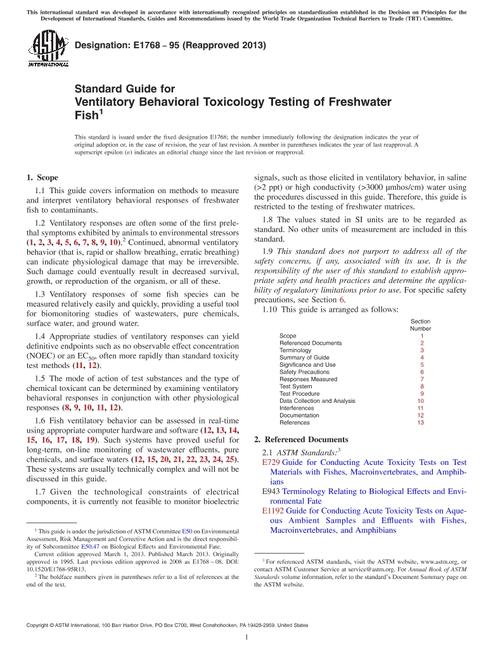
1.1 This guide covers information on methods to measure and interpret ventilatory behavioral responses of freshwater fish to contaminants.
1.2 Ventilatory responses are often some of the first prelethal symptoms exhibited by animals to environmental stressors (1, 2, 3, 4, 5, 6, 7, 8, 9, 10). Continued, abnormal ventilatory behavior (that is, rapid or shallow breathing, erratic breathing) can indicate physiological damage that may be irreversible. Such damage could eventually result in decreased survival, growth, or reproduction of the organism, or all of these.
1.3 Ventilatory responses of some fish species can be measured relatively easily and quickly, providing a useful tool for biomonitoring studies of wastewaters, pure chemicals, surface water, and ground water.
1.4 Appropriate studies of ventilatory responses can yield definitive endpoints such as no observable effect concentration (NOEC) or an EC50, often more rapidly than standard toxicity test methods (11, 12).
1.5 The mode of action of test substances and the type of chemical toxicant can be determined by examining ventilatory behavioral responses in conjunction with other physiological responses (8, 9, 10, 11, 12).
1.6 Fish ventilatory behavior can be assessed in real-time using appropriate computer hardware and software (12, 13, 14, 15, 16, 17, 18, 19). Such systems have proved useful for long-term, on-line monitoring of wastewater effluents, pure chemicals, and surface waters (12, 15, 20, 21, 23, 24, 25, ). These systems are typically complex technically and will not be discussed in this guide.
1.7 Given the technological constraints of electrical components, it is currently not feasible to monitor bioelectric signals, such as those elicited in ventilatory behavior, in saline (>2 ppt) or high conductivity (>3000 mhos/cm) water using the procedures discussed in this guide. Therefore, this guide is restricted to the testing of freshwater matrices.
1.8 This standard does not purport to address all of the safety concerns, if any, associated with its use. It is the responsibility of the user of this standard to establish appropriate safety and health practices and determine the applicability of regulatory limitations prior to use. For specific safety precautions, see Section 6.
1.9 This guide is arranged as follows:
Section NumberScopeReferenced DocumentsTerminologySummary of GuideSignificance and UseSafety PrecautionsResponses MeasuredTest SystemTest ProcedureData Collection and AnalysisInterferencesDocumentationReferences| File Size : | 1 file , 160 KB |
| Note : | This product is unavailable in Russia, Ukraine, Belarus |
| Number of Pages : | 10 |
| Published : | 11/10/1995 |