ASTM E1921-09ce1 PDF

ASTM E1921-09ce1 PDF

Name:
ASTM E1921-09ce1 PDF

Published Date:
06/15/2009

Status:
Active

Description:

Standard Test Method for Determination of Reference Temperature, To, for Ferritic Steels in the Transition Range

Publisher:
ASTM International

Document status:
Active

Format:
Electronic (PDF)

Delivery time:
10 minutes

Delivery time (for Russian version):
200 business days

SKU:

Choose Document Language:
$24.9
Need Help?

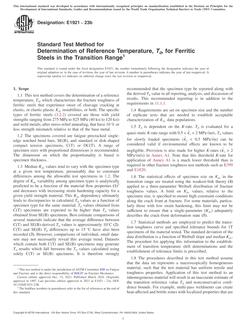
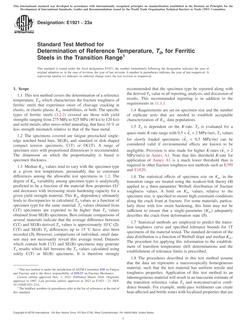
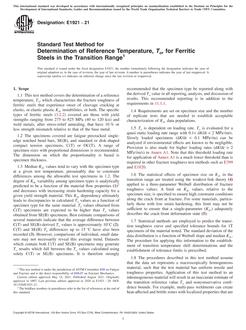
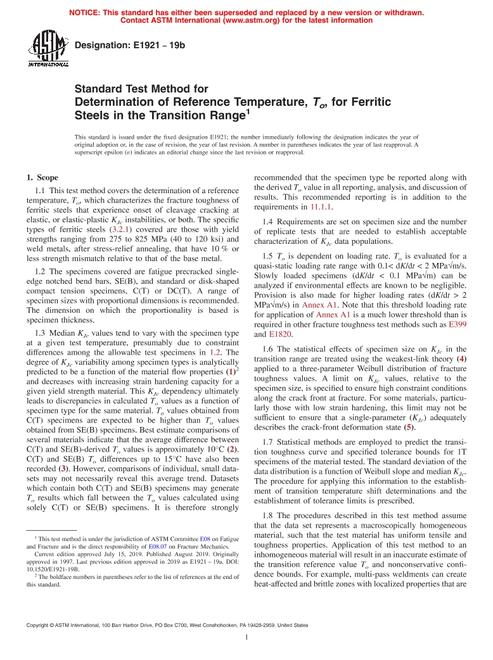
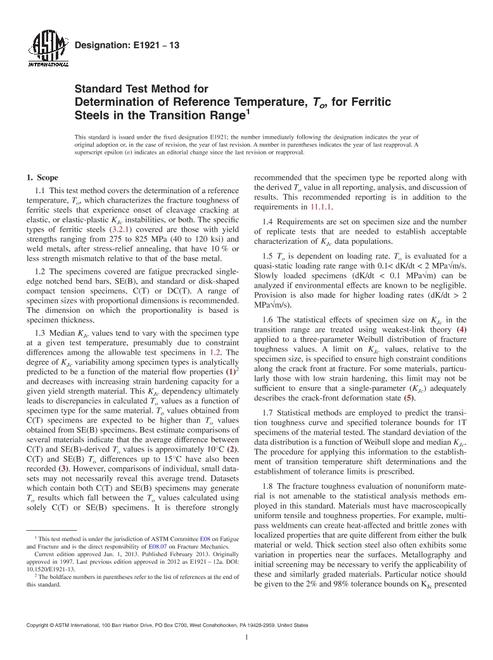
1.1 This test method covers the determination of a reference temperature, To, which characterizes the fracture toughness of ferritic steels that experience onset of cleavage cracking at elastic, or elastic-plastic KJc instabilities, or both. The specific types of ferritic steels (3.2.1) covered are those with yield strengths ranging from 275 to 825 MPa (40 to 120 ksi) and weld metals, after stress-relief annealing, that have 10 % or less strength mismatch relative to that of the base metal.

1.2 The specimens covered are fatigue precracked single-edge notched bend bars, SE(B), and standard or disk-shaped compact tension specimens, C(T) or DC(T). A range of specimen sizes with proportional dimensions is recommended. The dimension on which the proportionality is based is specimen thickness.

1.3 Median KJc values tend to vary with the specimen type at a given test temperature, presumably due to constraint differences among the allowable test specimens in 1.2. The degree of KJc variability among specimen types is analytically predicted to be a function of the material flow properties (1) and decreases with increasing strain hardening capacity for a given yield strength material. This KJc dependency ultimately leads to discrepancies in calculated To values as a function of specimen type for the same material. To values obtained from C(T) specimens are expected to be higher than To values obtained from SE(B) specimens. Best estimate comparisons of several materials indicate that the average difference between C(T) and SE(B)-derived To values is approximately 10°C (2). C(T) and SE(B) To differences up to 15°C have also been recorded (3). However, comparisons of individual, small datasets may not necessarily reveal this average trend. Datasets which contain both C(T) and SE(B) specimens may generate To results which fall between the To values calculated using solely C(T) or SE(B) specimens. It is therefore strongly recommended that the specimen type be reported along with the derived To value in all reporting, analysis, and discussion of results. This recommended reporting is in addition to the requirements in 11.1.1.

1.4 Requirements are set on specimen size and the number of replicate tests that are needed to establish acceptable characterization of KJc data populations.

1.5 To is dependent on loading rate. To is evaluated for a quasi-static loading rate range with 0.1< dK/dt < 2 MPam/s. Slowly loaded specimens (dK/dt < 0.1 MPam) can be analyzed if environmental effects are known to be negligible. Provision is also made for higher loading rates (dK/dt > 2 MPam/s).

1.6 The statistical effects of specimen size on KJc in the transition range are treated using weakest-link theory (4) applied to a three-parameter Weibull distribution of fracture toughness values. A limit on KJc values, relative to the specimen size, is specified to ensure high constraint conditions along the crack front at fracture. For some materials, particularly those with low strain hardening, this limit may not be sufficient to ensure that a single-parameter (KJc) adequately describes the crack-front deformation state (5).

1.7 Statistical methods are employed to predict the transition toughness curve and specified tolerance bounds for 1T specimens of the material tested. The standard deviation of the data distribution is a function of Weibull slope and median KJc. The procedure for applying this information to the establishment of transition temperature shift determinations and the establishment of tolerance limits is prescribed.

1.8 The fracture toughness evaluation of nonuniform material is not amenable to the statistical analysis methods employed in this standard. Materials must have macroscopically uniform tensile and toughness properties. For example, multipass weldments can create heat-affected and brittle zones with localized properties that are quite different from either the bulk material or weld. Thick section steel also often exhibits some variation in properties near the surfaces. Metallography and initial screening may be necessary to verify the applicability of these and similarly graded materials. Particular notice should be given to the 2% and 98% tolerance bounds on KJc presented in 9.3. Data falling outside these bounds may indicate nonuniform material properties.

1.9 This standard does not purport to address all of the safety concerns, if any, associated with its use. It is the responsibility of the user of this standard to establish appropriate safety and health practices and determine the applicability of regulatory limitations prior to use.


File Size : 1 file , 390 KB
Note : This product is unavailable in Russia, Ukraine, Belarus
Number of Pages : 22
Published : 06/15/2009
Redline File Size : 2 files , 790 KB

History

ASTM E1921-24
Published Date: 05/01/2024
Standard Test Method for Determination of Reference Temperature, T0, for Ferritic Steels in the Transition Range
$29.4
ASTM E1921-23b
Published Date: 12/15/2023
Standard Test Method for Determination of Reference Temperature, T0, for Ferritic Steels in the Transition Range
ASTM E1921-23a
Published Date: 11/01/2023
Standard Test Method for Determination of Reference Temperature, T0, for Ferritic Steels in the Transition Range
$35.1
ASTM E1921-23
Published Date: 06/01/2023
Standard Test Method for Determination of Reference Temperature, T0, for Ferritic Steels in the Transition Range
$32.4
ASTM E1921-22a
Published Date: 10/31/2022
Standard Test Method for Determination of Reference Temperature, T0, for Ferritic Steels in the Transition Range
$29.4
ASTM E1921-22
Published Date: 07/14/2022
Standard Test Method for Determination of Reference Temperature, T0, for Ferritic Steels in the Transition Range
$29.4
ASTM E1921-21a
Published Date: 10/01/2021
Standard Test Method for Determination of Reference Temperature, T0, for Ferritic Steels in the Transition Range
$27.6
ASTM E1921-21
Published Date: 05/15/2021
Standard Test Method for Determination of Reference Temperature, To, for Ferritic Steels in the Transition Range
$22.5
ASTM E1921-20
Published Date: 06/01/2020
Standard Test Method for Determination of Reference Temperature,T o, for Ferritic Steels in the Transition Range
$26.7
ASTM E1921-19be1
Published Date: 07/15/2019
Standard Test Method for Determination of Reference Temperature, To, for Ferritic Steels in the Transition Range
$25.8
ASTM E1921-19b
Published Date: 07/15/2019
Standard Test Method for Determination of Reference Temperature, To, for Ferritic Steels in the Transition Range
$25.8
ASTM E1921-19a
Published Date: 05/01/2019
Standard Test Method for Determination of Reference Temperature, To, for Ferritic Steels in the Transition Range
$24.9
ASTM E1921-19
Published Date: 02/01/2019
Standard Test Method for Determination of Reference Temperature, To, for Ferritic Steels in the Transition Range
$24.9
ASTM E1921-18a
Published Date: 10/01/2018
Standard Test Method for Determination of Reference Temperature, To, for Ferritic Steels in the Transition Range
$24.9
ASTM E1921-18
Published Date: 01/15/2018
Standard Test Method for Determination of Reference Temperature, To, for Ferritic Steels in the Transition Range
$24.9
ASTM E1921-13a
Published Date: 11/15/2013
Standard Test Method for Determination of Reference Temperature, To, for Ferritic Steels in the Transition Range
$24.9
ASTM E1921-13
Published Date: 01/01/2013
Standard Test Method for Determination of Reference Temperature, To, for Ferritic Steels in the Transition Range
$24.9
ASTM E1921-12a
Published Date: 11/15/2012
Standard Test Method for Determination of Reference Temperature, To, for Ferritic Steels in the Transition Range
$24.9
ASTM E1921-12
Published Date: 05/01/2012
Standard Test Method for Determination of Reference Temperature, To, for Ferritic Steels in the Transition Range
$24.9
ASTM E1921-11a
Published Date: 10/01/2011
Standard Test Method for Determination of Reference Temperature, To, for Ferritic Steels in the Transition Range
$24.9
ASTM E1921-11
Published Date: 05/01/2011
Standard Test Method for Determination of Reference Temperature, To, for Ferritic Steels in the Transition Range
$26.7
ASTM E1921-10e1
Published Date: 05/01/2010
Standard Test Method for Determination of Reference Temperature, To, for Ferritic Steels in the Transition Range
$24.9
ASTM E1921-10
Published Date: 05/01/2010
Standard Test Method for Determination of Reference Temperature, To, for Ferritic Steels in the Transition Range
$24.9
ASTM E1921-09ce2
Published Date: 06/15/2009
Standard Test Method for Determination of Reference Temperature, To, for Ferritic Steels in the Transition Range
$24.9
ASTM E1921-09ce1
Published Date: 06/15/2009
Standard Test Method for Determination of Reference Temperature, To, for Ferritic Steels in the Transition Range
$24.9
ASTM E1921-09c
Published Date: 06/15/2009
Standard Test Method for Determination of Reference Temperature, To, for Ferritic Steels in the Transition Range
$24.9
ASTM E1921-09b
Published Date: 06/01/2009
Standard Test Method for Determination of Reference Temperature, To, for Ferritic Steels in the Transition Range
$24.9
ASTM E1921-09a
Published Date: 02/15/2009
Standard Test Method for Determination of Reference Temperature, To, for Ferritic Steels in the Transition Range
$24.9
ASTM E1921-09
Published Date: 01/01/2009
Standard Test Method for Determination of Reference Temperature, To, for Ferritic Steels in the Transition Range
$24.9
ASTM E1921-08ae1
Published Date: 05/15/2008
Standard Test Method for Determination of Reference Temperature, To, for Ferritic Steels in the Transition Range
$24.9
ASTM E1921-08a
Published Date: 05/15/2008
Standard Test Method for Determination of Reference Temperature, To, for Ferritic Steels in the Transition Range
$24.9
ASTM E1921-08
Published Date: 01/15/2008
Standard Test Method for Determination of Reference Temperature, To, for Ferritic Steels in the Transition Range
$24.9
ASTM E1921-07
Published Date: 12/15/2007
Standard Test Method for Determination of Reference Temperature, To, for Ferritic Steels in the Transition Range
$24.9
ASTM E1921-05
Published Date: 01/01/2005
Standard Test Method for Determination of Reference Temperature, To', for Ferritic Steels in the Transition Range
$19.5
ASTM E1921-03
Published Date: 11/01/2003
Standard Test Method for Determination of Reference Temperature, To', for Ferritic Steels in the Transition Range
$19.5
ASTM E1921-02
Published Date: 03/10/2002
Standard Test Method for Determination of Reference Temperature, To, for Ferritic Steels in the Transition Range
$19.5
ASTM E1921-97
Published Date: 01/01/1997
Standard Test Method for Determination of Reference Temperature, To, for Ferritic Steels in the Transition Range
$19.5

Related products

ASTM E21-20
Published Date: 09/01/2020
Standard Test Methods for Elevated Temperature Tension Tests of Metallic Materials
$15.6
ASTM E1245-03(2023)
Published Date: 04/01/2023
Standard Practice for Determining the Inclusion or Second-Phase Constituent Content of Metals by Automatic Image Analysis
$17.1
ASTM E8/E8M-24
Published Date: 01/01/2024
Standard Test Methods for Tension Testing of Metallic Materials
$27
ASTM E112-24
Published Date: 04/01/2024
Standard Test Methods for Determining Average Grain Size
$27

Best-Selling Products

IAPMO 150-2007
Published Date: 2007
Vacuum Sewage, Grease Waste and/or Condensate Collection Systems
$19.5
IAPMO 2012 Green Plumbing and Mechanical Code Supplement
Published Date: 04/01/2012
2012 Green Plumbing and Mechanical Code Supplement - For Use with All Codes
$18.3
IAPMO /ANSI/CAN/ASSE 1055-2020
Published Date: 2020
Performance Requirements for Chemical Dispensers with Integral Backflow Protection
$13.5
IAPMO /ANSI/CAN/ASSE 1055-2020
Published Date: 2023
Performance Requirements for Chemical Dispensers with Integral Backflow Protection
$13.5
IAPMO /ANSI/CAN/ASSE 1103-2024
Published Date: 2024
Performance Requirements for Pilot Operated Water Pressure Reducing Valves for Potable Water
$13.5
IAPMO /ANSI/CAN/ISO 30500:2019
Published Date: 2019
Non-sewered sanitation systems - Prefabricated integrated treatment units - General safety and performance requirements for design and testing (ISO 30500:2018, IDT)
$66