Name:
ASTM E1931-97(2003) PDF
Published Date:
03/10/2003
Status:
Active
Publisher:
ASTM International
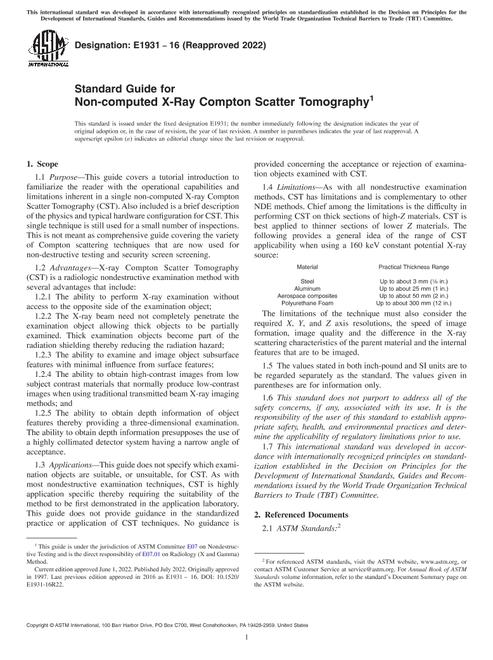
1.1 Purpose - This guide covers a tutorial introduction to familiarize the reader with the operational capabilities and limitations inherent in X-ray Compton Scatter Tomography (CST). Also included is a brief description of the physics and typical hardware configuration for CST.
1.2 Advantages - X-ray Compton Scatter Tomography (CST) is a radiologic nondestructive examination method with several advantages that include:
1.2.1 The ability to perform X-ray examination without access to the opposite side of the examination object;
1.2.2 The X-ray beam need not completely penetrate the examination object allowing thick objects to be partially examined. Thick examination objects become part of the radiation shielding thereby reducing the radiation hazard;
1.2.3 The ability to image examination object subsurface features with minimal influence from surface features;
1.2.4 The ability to obtain high-contrast images from low subject contrast materials that normally produce low-contrast images when using traditional transmitted beam X-ray imaging methods; and
1.2.5 The ability to obtain depth information for examination object features thereby providing three-dimensional examination. The ability to obtain depth information presupposes the use of a highly collimated detector system having a narrow angle of acceptance.
1.3 Applications - This guide does not specify which examination objects are suitable, or unsuitable, for CST. As with most nondestructive examination techniques, CST is highly application specific thereby requiring the suitability of the method to be first demonstrated in the application laboratory. This guide does not provide guidance in the standardized practice or application of CST techniques. No guidance is provided concerning the acceptance or rejection of examination objects examined with CST.
1.4 Limitations - As with all nondestructive examination methods, CST has limitations and is complementary to other NDE methods. Chief among the limitations is the difficulty in performing CST on thick sections of high-Z materials. CST is best applied to thinner sections of lower Z materials. The following provides a general idea of the range of CST applicability when using a 160 keV constant potential X-ray source:
Material Practical Thickness RangeSteelUp to about 3 mm [1/8 in.]AluminumUp to about 25 mm [1 in.]Aerospace compositesUp to about 50 mm [2 in.]The limitations of the technique must also consider the required X, Y, and Z axis resolutions, the speed of image formation, image quality and the difference in the X-ray scattering characteristics of the parent material and the internal features that are to be imaged.
1.5 The values stated in both inch-pound and SI units are to be regarded separately as the standard. The values given in parentheses are for information only.
1.6 This standard does not purport to address all of the safety concerns, if any, associated with its use. It is the responsibility of the user of this standard to establish appropriate safety and health practices and to determine the applicability of regulatory limitations prior to use.
| File Size : | 1 file , 150 KB |
| Note : | This product is unavailable in Russia, Ukraine, Belarus |
| Number of Pages : | 14 |
| Published : | 03/10/2003 |