ASTM E2092-00 PDF

ASTM E2092-00 PDF

Name:
ASTM E2092-00 PDF

Published Date:
05/10/2000

Status:
Active

Description:

Standard Test Method for Distortion Temperature in Three-Point Bending by Thermomechanical Analysis

Publisher:
ASTM International

Document status:
Active

Format:
Electronic (PDF)

Delivery time:
10 minutes

Delivery time (for Russian version):
200 business days

SKU:

Choose Document Language:
$17.4
Need Help?

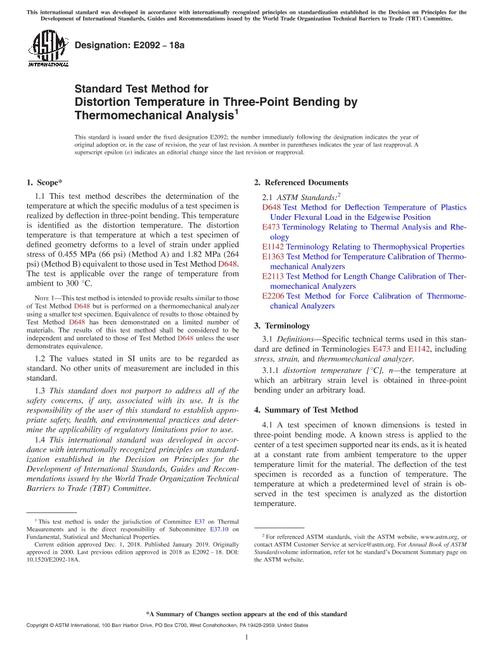
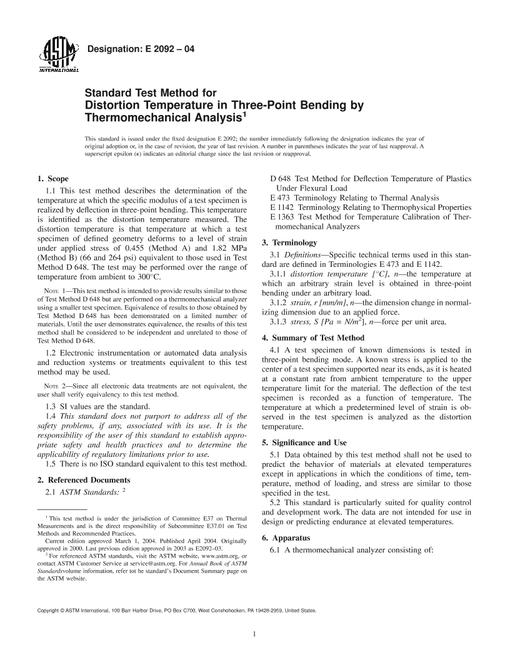
1.1 This test method describes the determination of the temperature at which the specific modulus of a test specimen is realized by deflection in three-point bending. This temperature is identified as the distortion temperature measured. The distortion temperature is that temperature at which a test specimen of defined geometry deforms to a level of strain under applied stress of 0.455 and 1.82 MPa (66 and 264 psi) equivalent to those used in Test Method D 648. The test may be performed over the range of temperature from ambient to 300C.

Note 1

Results may or may not agree with those obtained by Test Method D 648.

1.2 Electronic instrumentation or automated data analysis and reduction systems or treatments equivalent to this test method may be used.

Note 2

Since all electronic data treatments are not equivalent, the user shall verify equivalency to this test method.

1.3 SI values are to be regarded as the standard. Inch-pound units in parentheses are for information only.

This standard does not purport to address all of the safety problems, if any, associated with its use. It is the responsibility of the user of this standard to establish appropriate safety and health practices and to determine the applicability of regulatory limitations prior to use.

1.4 There is no ISO standard equivalent to this test method.


File Size : 1 file , 60 KB
Note : This product is unavailable in Russia, Ukraine, Belarus
Number of Pages : 5
Published : 05/10/2000

History

ASTM E2092-23
Published Date: 11/01/2023
Standard Test Method for Distortion Temperature in Three-Point Bending by Thermomechanical Analysis
$18.9
ASTM E2092-18a
Published Date: 12/01/2018
Standard Test Method for Distortion Temperature in Three-Point Bending by Thermomechanical Analysis
$22.5
ASTM E2092-18
Published Date: 06/01/2018
Standard Test Method for Distortion Temperature in Three-Point Bending by Thermomechanical Analysis
$17.4
ASTM E2092-13
Published Date: 09/01/2013
Standard Test Method for Distortion Temperature in Three-Point Bending by Thermomechanical Analysis
$17.4
ASTM E2092-09
Published Date: 09/01/2009
Standard Test Method for Distortion Temperature in Three-Point Bending by Thermomechanical Analysis
$17.4
ASTM E2092-04
Published Date: 03/01/2004
Standard Test Method for Distortion Temperature in Three-Point Bending by Thermomechanical Analysis
$17.4
ASTM E2092-03
Published Date: 01/01/2003
Standard Test Method for Distortion Temperature in Three-Point Bending by Thermomechanical Analysis
$17.4
ASTM E2092-00
Published Date: 05/10/2000
Standard Test Method for Distortion Temperature in Three-Point Bending by Thermomechanical Analysis
$17.4

Related products

ASTM E1142-24
Published Date: 05/01/2024
Standard Terminology Relating to Thermophysical Properties
$18.9
ASTM E2125-19
Published Date: 11/01/2019
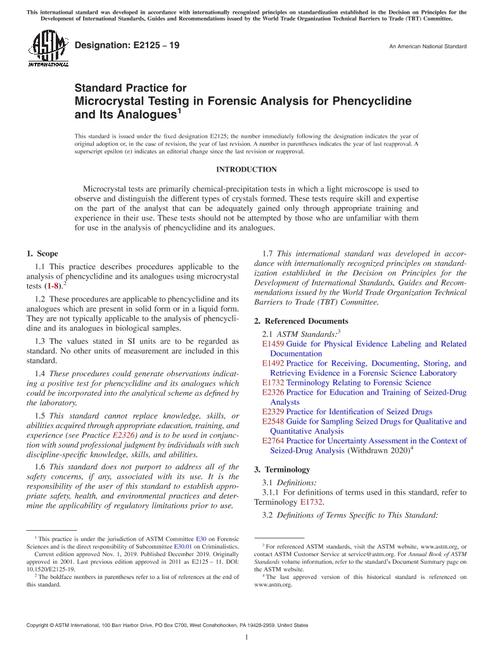
Standard Practice for Microcrystal Testing in Forensic Analysis for Phencyclidine and Its Analogues
$14.4
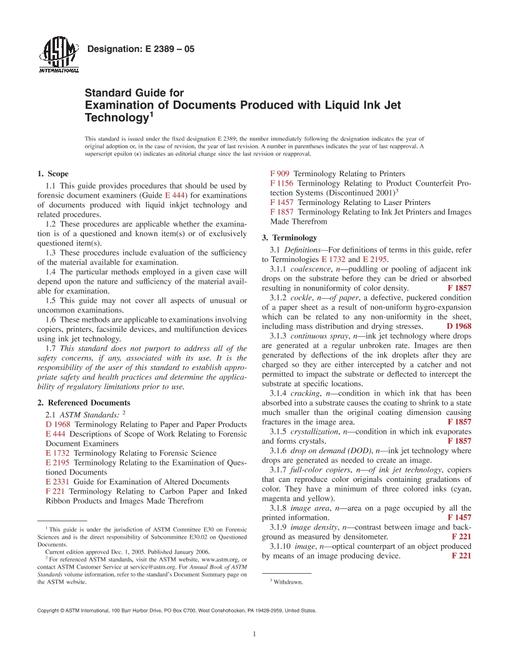
ASTM E2389-05
Published Date: 12/01/2005
Standard Guide for Examination of Documents Produced with Liquid Ink Jet Technology (Withdrawn 2014)
$15
ASTM E2494-08
Published Date: 07/01/2008
Standard Guide for Examination of Typewritten Items (Withdrawn 2017)
$17.4

Best-Selling Products

AOAC METHODS
Published Date: 01/01/2002
AOAC OFFICIAL METHODS OF ANALYSIS
AOAC METHODS
Published Date: 01/01/2007
AOAC OFFICIAL METHODS OF ANALYSIS
AOAC METHODS
Published Date: 01/01/1990
AOAC OFFICIAL METHODS OF ANALYSIS
$135
AOAC METHODS
Published Date: 01/01/1995
AOAC OFFICIAL METHODS OF ANALYSIS
AOAC METHODS
Published Date: 01/01/2006
AOAC OFFICIAL METHODS OF ANALYSIS
AOAC METHODS
Published Date: 01/01/1999
AOAC OFFICIAL METHODS OF ANALYSIS