Name:
ASTM E2183-02 PDF
Published Date:
01/10/2002
Status:
[ Withdrawn ]
Publisher:
ASTM International
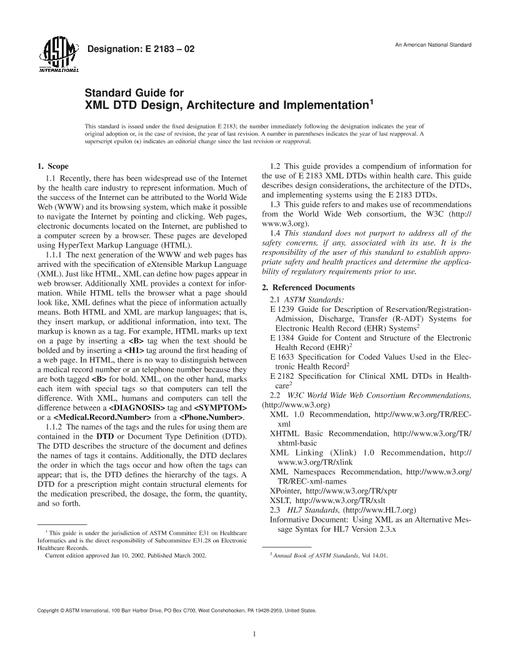
1.1 Recently, there has been widespread use of the Internet by the health care industry to represent information. Much of the success of the Internet can be attributed to the World Wide Web (WWW) and its browsing system, which make it possible to navigate the Internet by pointing and clicking. Web pages, electronic documents located on the Internet, are published to a computer screen by a browser. These pages are developed using HyperText Markup Language (HTML).
1.1.1 The next generation of the WWW and web pages has arrived with the specification of eXtensible Markup Language (XML). Just like HTML, XML can define how pages appear in web browser. Additionally XML provides a context for information. While HTML tells the browser what a page should look like, XML defines what the piece of information actually means. Both HTML and XML are markup languages; that is, they insert markup, or additional information, into text. The markup is known as a tag. For example, HTML marks up text on a page by inserting a B> tag when the text should be bolded and by inserting a H1> tag around the first heading of a web page. In HTML, there is no way to distinguish between a medical record number or an telephone number because they are both tagged B> for bold. XML, on the other hand, marks each item with special tags so that computers can tell the difference. With XML, humans and computers can tell the difference between a DIAGNOSIS> tag and SYMPTOM> or a Medical.Record.Number> from a Phone.Number>.
1.1.2 The names of the tags and the rules for using them are contained in the DTD or Document Type Definition (DTD). The DTD describes the structure of the document and defines the names of tags it contains. Additionally, the DTD declares the order in which the tags occur and how often the tags can appear; that is, the DTD defines the hierarchy of the tags. A DTD for a prescription might contain structural elements for the medication prescribed, the dosage, the form, the quantity, and so forth.
1.2 This guide provides a compendium of information for the use of E 2183 XML DTDs within health care. This guide describes design considerations, the architecture of the DTDs, and implementing systems using the E 2183 DTDs.
1.3 This guide refers to and makes use of recommendations from the World Wide Web consortium, the W3C (http://www.w3.org).
1.4 This standard does not purport to address all of the safety concerns, if any, associated with its use. It is the responsibility of the user of this standard to establish appropriate safety and health practices and determine the applicability of regulatory requirements prior to use.
| File Size : | 1 file , 150 KB |
| Note : | This product is unavailable in Russia, Ukraine, Belarus |
| Number of Pages : | 14 |
| Published : | 01/10/2002 |