Name:
ASTM E351-93(2000)e1 PDF
Published Date:
01/01/2000
Status:
Active
Publisher:
ASTM International
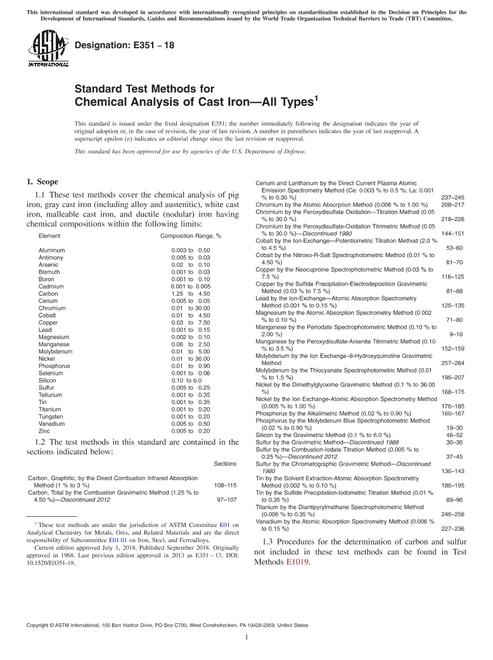
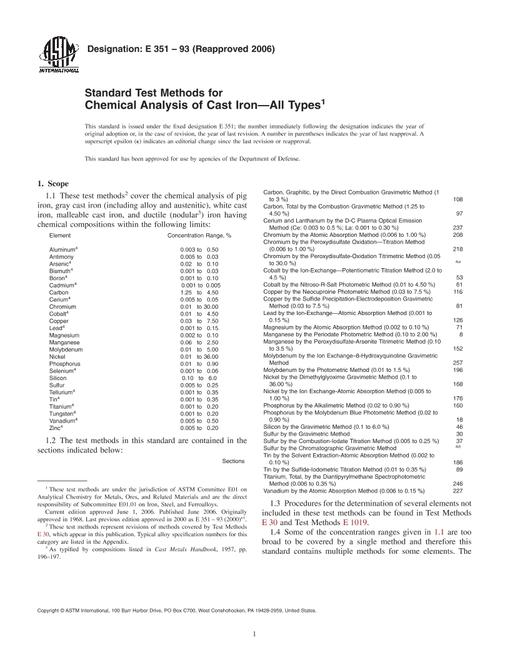
1.1 These test methods cover the chemical analysis of pig iron, gray cast iron (including alloy and austenitic), white cast iron, malleable cast iron, and ductile (nodular) iron having chemical compositions within the following limits:
Element Concentration Range, %Aluminum40.003 to 0.50Antimony0.005 to 0.03Arsenic40.02 to 0.10Bismuth40.001 to 0.03Boron40.001 to 0.10Cadmium40.001 to0.005Carbon 1.25 to 4.50Cerium40.005 to 0.05Chromium0.01 to 30.00Cobalt40.01 to 4.50Copper 0.03 to 7.50Lead40.001 to 0.15Magnesium0.002 to 0.10Manganese0.06 to 2.50Molybdenum0.01 to 5.00Nickel 0.01 to 36.00Phosphorus0.01 to 0.90Selenium40.001 to 0.06Silicon 0.10 to 6.0Sulfur 0.005 to 0.25Tellurium40.001 to 0.35Tin40.001 to 0.35Titanium40.001 to 0.20Tungsten40.001 to 0.20Vanadium40.005 to 0.50Zinc40.005 to 0.201.2 The test methods in this standard are contained in the sections indicated below:
SectionsCarbon, Graphitic, by the Direct Combustion Gravimetric Method (1 to 3 %) 108Carbon, Total by the Combustion Gravimetric Method (1.25 to 4.50 %) 97Cerium and Lanthanum by the D-C Plasma Optical Emission Method (Ce: 0.003 to 0.5 %; La: 0.001 to 0.30 %)237Chromium by the Atomic Absorption Method (0.006 to 1.00 %) 208Chromium by the Peroxydisulfate Oxidation-Titration Method (0.006 to 1.00 %) 218Chromium by the Peroxydisulfate-Oxidation Titrimetric Method (0.05 to 30.0 %) 4a Cobalt by the Ion-Exchange-Potentiometric Titration Method (2.0 to 4.5 %) 53Cobalt by the Nitroso-R-Salt Photometric Method (0.01 to 4.50 %) 61Copper by the Neocuproine Photometric Method (0.03 to 7.5 %) 116Copper by the Sulfide Precipitation-Electrodeposition Gravimetric Method (0.03 to 7.5 %) 81Lead by the Ion-Exchange-Atomic Absorption Method (0.001 to 0.15 %) 126Magnesium by the Atomic Absorption Method (0.002 to 0.10 %) 71Manganese by the Periodate Photometric Method (0.10 to 2.00 %) 8Manganese by the Peroxydisulfate-Arsenite Titrimetric Method (0.10 to 3.5 %) 152Molybdenum by the Ion Exchange-8-Hydroxyquinoline Gravimetric Method 257Molybdenum by the Photometric Method (0.01 to 1.5 %) 196Nickel by the Dimethylglyoxime Gravimetric Method (0.1 to 36.00 %) 168Nickel by the Ion Exchange-Atomic Absorption Method (0.005 to 1.00 %) 176Phosphorus by the Alkalimetric Method (0.02 to 0.90 %) 160Phosphorus by the Molybdenum Blue Photometric Method (0.02 to 0.90 %) 18Silicon by the Gravimetric Method (0.1 to 6.0 %) 46Sulfur by the Gravimetric Method 30Sulfur by the Combustion-Iodate Titration Method (0.005 to 0.25 %) 37Sulfur by the Chromatographic Gravimetric Method 4bTin by the Solvent Extraction-Atomic Absorption Method (0.002 to 0.10 %) 186Tin by the Sulfide-Iodometric Titration Method (0.01 to 0.35 %) 89Titanium, Total, by the Diantipyrylmethane Spectrophotometric Method (0.006 to 0.35 %) 246Vanadium by the Atomic Absorption Method (0.006 to 0.15 %) 2271.3 Methods for the determination of several elements not included in this standard can be found in Test Methods E30 and Test Methods E1019.
1.4 Some of the concentration ranges given in 1.1 are too broad to be covered by a single method and therefore this standard contains multiple methods for some elements. The user must select the proper method by matching the information given in the Scope and Interference sections of each method with the composition of the alloy to be analyzed.
1.5 The values stated in SI units are to be regarded as standard. In some cases, exceptions allowed in Practice E380 are also used.
1.6 This standard does not purport to address all of the safety concerns, if any, associated with its use. It is the responsibility of the user of this standard to establish appropriate safety and health practices and determine the applicability of regulatory limitations prior to use. Specific hazards statements are given in Section 5 and in special "Warning" paragraphs throughout these Methods.
| File Size : | 1 file , 360 KB |
| Note : | This product is unavailable in Russia, Ukraine, Belarus |
| Number of Pages : | 48 |
| Published : | 01/01/2000 |