ASTM E415-17 PDF

ASTM E415-17 PDF

Name:
ASTM E415-17 PDF

Published Date:
05/15/2017

Status:
Active

Description:

Standard Test Method for Analysis of Carbon and Low-Alloy Steel by Spark Atomic Emission Spectrometry

Publisher:
ASTM International

Document status:
Active

Format:
Electronic (PDF)

Delivery time:
10 minutes

Delivery time (for Russian version):
200 business days

SKU:

Choose Document Language:
$21.6
Need Help?

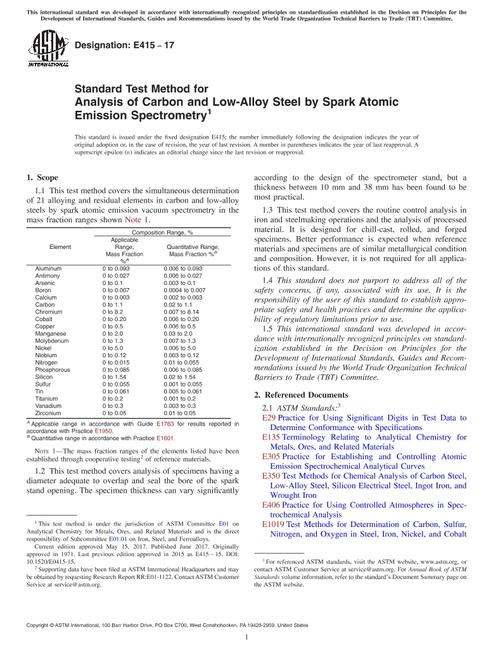
1.1 This test method covers the simultaneous determination of 21 alloying and residual elements in carbon and low-alloy steels by spark atomic emission vacuum spectrometry in the mass fraction ranges shown Note 1.

Element

Composition Range, %

Applicable Range,
Mass Fraction %A

Quantitative Range,
Mass Fraction %B

Aluminum

0 to 0.093

0.006 to 0.093

Antimony

0 to 0.027

0.006 to 0.027

Arsenic

0 to 0.1

0.003 to 0.1

Boron

0 to 0.007

0.0004 to 0.007

Calcium

0 to 0.003

0.002 to 0.003

Carbon

0 to 1.1

0.02 to 1.1

Chromium

0 to 8.2

0.007 to 8.14

Cobalt

0 to 0.20

0.006 to 0.20

Copper

0 to 0.5

0.006 to 0.5

Manganese

0 to 2.0

0.03 to 2.0

Molybdenum

0 to 1.3

0.007 to 1.3

Nickel

0 to 5.0

0.006 to 5.0

Niobium

0 to 0.12

0.003 to 0.12

Nitrogen

0 to 0.015

0.01 to 0.055

Phosphorous

0 to 0.085

0.006 to 0.085

Silicon

0 to 1.54

0.02 to 1.54

Sulfur

0 to 0.055

0.001 to 0.055

Tin

0 to 0.061

0.005 to 0.061

Titanium

0 to 0.2

0.001 to 0.2

Vanadium

0 to 0.3

0.003 to 0.3

Zirconium

0 to 0.05

0.01 to 0.05

(A) Applicable range in accordance with Guide E1763 for results reported in accordance with Practice E1950.
(B) Quantitative range in accordance with Practice E1601.

Note 1: The mass fraction ranges of the elements listed have been established through cooperative testing2 of reference materials.

1.2 This test method covers analysis of specimens having a diameter adequate to overlap and seal the bore of the spark stand opening. The specimen thickness can vary significantly according to the design of the spectrometer stand, but a thickness between 10 mm and 38 mm has been found to be most practical.

1.3 This test method covers the routine control analysis in iron and steelmaking operations and the analysis of processed material. It is designed for chill-cast, rolled, and forged specimens. Better performance is expected when reference materials and specimens are of similar metallurgical condition and composition. However, it is not required for all applications of this standard.

1.4 This standard does not purport to address all of the safety concerns, if any, associated with its use. It is the responsibility of the user of this standard to establish appropriate safety and health practices and determine the applicability of regulatory limitations prior to use.

1.5 This international standard was developed in accordance with internationally recognized principles on standardization established in the Decision on Principles for the Development of International Standards, Guides and Recommendations issued by the World Trade Organization Technical Barriers to Trade (TBT) Committee.


File Size : 1 file , 110 KB
Note : This product is unavailable in Russia, Ukraine, Belarus
Number of Pages : 11
Published : 05/15/2017
Redline File Size : 2 files , 200 KB

History

ASTM E415-21
Published Date: 10/01/2021
Standard Test Method for Analysis of Carbon and Low-Alloy Steel by Spark Atomic Emission Spectrometry
$18
ASTM E415-17
Published Date: 05/15/2017
Standard Test Method for Analysis of Carbon and Low-Alloy Steel by Spark Atomic Emission Spectrometry
$21.6
ASTM E415-14
Published Date: 03/01/2014
Standard Test Method for Analysis of Carbon and Low-Alloy Steel by Spark Atomic Emission Spectrometry
$18
ASTM E415-08
Published Date: 06/01/2008
Standard Test Method for Atomic Emission Vacuum Spectrometric Analysis of Carbon and Low-Alloy Steel
$18
ASTM E415-99a(2005)
Published Date: 01/01/2005
Standard Test Method for Optical Emission Vacuum Spectrometric Analysis of Carbon and Low-Alloy Steel
$18
ASTM E415-99a
Published Date: 11/10/1999
Standard Test Method for Optical Emission Vacuum Spectrometric Analysis of Carbon and Low-Alloy Steel
$17.4

Related products

ASTM E364-94(2000)
Published Date: 01/01/2000
Standard Test Methods for Chemical Analysis of Ferrochrome-Silicon (Withdrawn 2006)
$17.4
ASTM E53-07(2013)
Published Date: 10/01/2013
Standard Test Method for Determination of Copper in Unalloyed Copper by Gravimetry (Withdrawn 2022)
$16.8

Best-Selling Products

ISO/DIS 10360-5:1998
Published Date: 07/01/1998
Geometrical Product Specifications (GPS) - Acceptance and reverification tests for coordinate measuring machines (CMM) - Part 5: CMMs used with multiple styli
$9.9
ISO/DIS 11608-3:1998
Published Date: 12/01/1998
Pen-Injectors for Medical Use - Part 3: Finished Cartridges - Requirements and Test Methods
$15.3
ISO/DIS 11614:1994
Published Date: 05/26/1994
Reciprocating Internal Combustion Compression-Ignition Engines - Apparatus for Measurement of the Opacity and for Determination of the Light Absorption Coefficient of Exhaust Gas - DRAFT
$22.5
ISO/DIS 1179-2:1995
Published Date: 09/01/1995
Connections for General Use and Fluid Power - Ports and Stud Ends with ISO 228-1 Threads with Elastomeric or Metal-to-Metal Sealing - Part 2: Heavy-Duty (S series) and Light-Duty (L series) Stud Ends with Elastomeric Sealing (type E) (Revision of ISO 1179:1981)
$9.9
ISO/DIS 1179-3:1995
Published Date: 09/01/1995
Connections for General Use and Fluid Power - Ports and Stud Ends with ISO 228-1 Threads with Elastomeric or Metal-to-Metal Sealing - Part 3: Light-Duty (L series) Stud Ends with Sealing by O-Ring with Retaining Ring (Types G and H) (Revision of ISO 1179:1981)
$11.4
ISO/DIS 1179-4:1995
Published Date: 09/01/1995
Connections for General Use and Fluid Power - Ports and Stud Ends with ISO 228-1 Threads with Elastomeric or Metal-to-Metal Sealing - Part 4: Stud Ends for General Use Only with Metal-to-Metal Sealing (Type B) (Revision of ISO 1179:1981)
$9.9
