Name:
ASTM E691-11 PDF
Published Date:
11/01/2011
Status:
Active
Publisher:
ASTM International
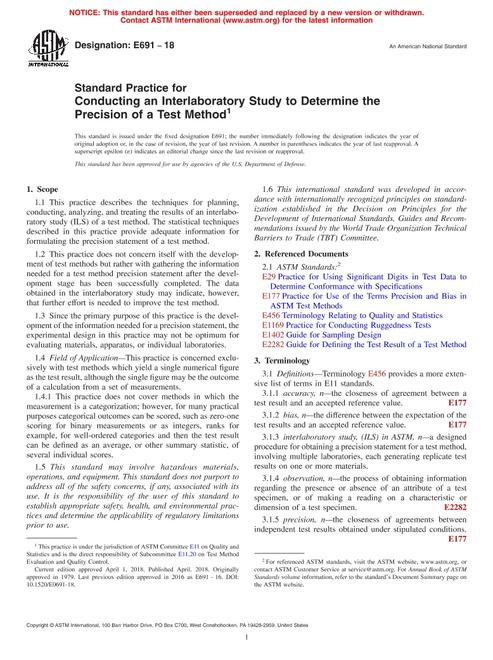
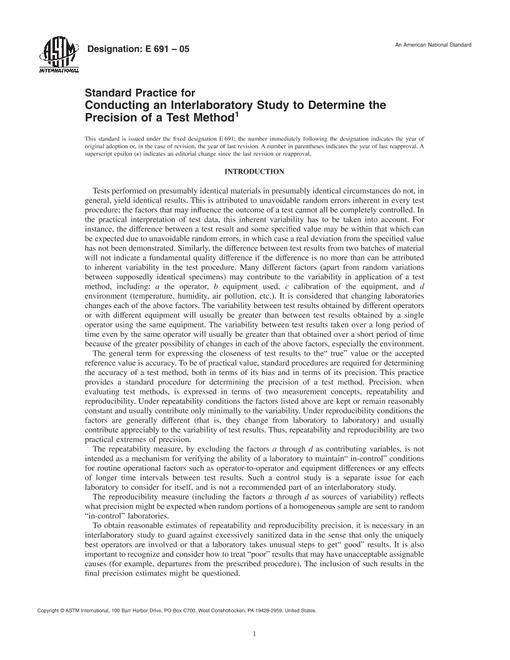
1.1 This practice describes the techniques for planning, conducting, analyzing, and treating the results of an interlaboratory study (ILS) of a test method. The statistical techniques described in this practice provide adequate information for formulating the precision statement of a test method.
1.2 This practice does not concern itself with the development of test methods but rather with gathering the information needed for a test method precision statement after the development stage has been successfully completed. The data obtained in the interlaboratory study may indicate, however, that further effort is needed to improve the test method.
1.3 Since the primary purpose of this practice is the development of the information needed for a precision statement, the experimental design in this practice may not be optimum for evaluating materials, apparatus, or individual laboratories.
1.4 Field of Application - This practice is concerned exclusively with test methods which yield a single numerical figure as the test result, although the single figure may be the outcome of a calculation from a set of measurements.
1.4.1 This practice does not cover methods in which the measurement is a categorization, such as a go-no-go allocation (two categories) or a sorting scheme into two or more categories. For practical purposes, the discontinuous nature of measurements of these types may be ignored when a test result is defined as an average of several individual measurements. Then, this practice may be applicable, but caution is required and a statistician should be consulted.
1.5 The information in this practice is arranged as follows:
Section Scope1 Referenced Documents2 Terminology3 Summary of Practice4 Significance and Use5 Planning the Interlaboratory Study (ILS)Section ILS Membership6 Basic Design7 Test Method8 Laboratories9 Materials10 Number of Test Results per Material11 Protocol12 Conducting the Testing Phase of the ILSSection Pilot Run13 Full Scale Run14 Calculation and Display of StatisticsSection Calculation of the Statistics15 Tabular and Graphical Display of Statistics16 Data ConsistencySection Flagging Inconsistent Results17 Investigation18 Task Group Actions19 Examples of Interlaboratory Studies20 Precision Statement InformationSection Repeatability and Reproducibility21 AppendixesAppendix Theoretical ConsiderationsX1 Index to Selected TermsX2 References Tables and Figures Table Glucose in Serum Example1-4, 6-7, 11 Pentosans in Pulp Example8-10, 12 Critical Values of Consistency Statistics, h and k5 Figure Glucose in Serum Example 1-4, 8 Pentosans in Pulp Example 5-7, 91.6 This standard may involve hazardous materials, operations, and equipment. This standard does not purport to address all of the safety problems associated with its use. It is the responsibility of the user of this standard to establish appropriate safety and health practices and determine the applicability of regulatory limitations prior to use.
| File Size : | 1 file , 240 KB |
| Note : | This product is unavailable in Russia, Ukraine, Belarus |
| Number of Pages : | 23 |
| Published : | 11/01/2011 |
| Redline File Size : | 2 files , 560 KB |