ASTM E722-94(2002) PDF

ASTM E722-94(2002) PDF

Name:
ASTM E722-94(2002) PDF

Published Date:
01/01/2002

Status:
Active

Description:

Standard Practice for Characterizing Neutron Energy Fluence Spectra in Terms of an Equivalent Monoenergetic Neutron Fluence for Radiation-Hardness Testing of Electronics

Publisher:
ASTM International

Document status:
Active

Format:
Electronic (PDF)

Delivery time:
10 minutes

Delivery time (for Russian version):
200 business days

SKU:

Choose Document Language:
$19.5
Need Help?

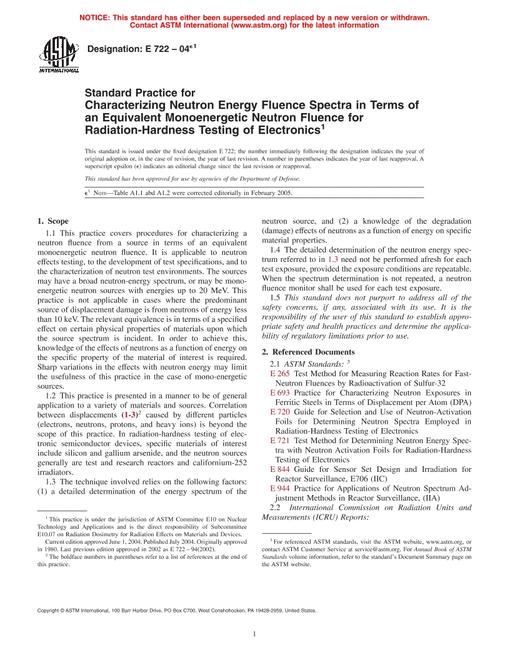
1.1 This practice covers procedures for characterizing a neutron fluence from a source in terms of an equivalent monoenergetic neutron fluence. It is applicable to neutron effects testing, to the development of test specifications, and to the characterization of neutron test environments. The sources may have a broad neutron-energy spectrum, or may be mono-energetic neutron sources with energies up to 20 MeV. The relevant equivalence is in terms of a specified effect on certain physical properties of materials upon which the source spectrum is incident. In order to achieve this, knowledge of the effects of neutrons as a function of energy on the specific property of the material of interest is required. Sharp variations in the effects with neutron energy may limit the usefulness of this practice in the case of mono-energetic sources.

1.2 This practice is presented in a manner to be of general application to a variety of materials and sources. Correlation between displacements () caused by different particles (electrons, neutrons, protons, and heavy ions) is beyond the scope of this practice. In radiation-hardness testing of electronic semiconductor devices, specific materials of interest include silicon and gallium arsenide, and the neutron sources generally are test and research reactors and californium-252 irradiators.

1.3 The technique involved relies on the following factors: (1) a detailed determination of the energy spectrum of the neutron source, and (2) a knowledge of the degradation (damage) effects of neutrons as a function of energy on specific material properties.

1.4 The detailed determination of the neutron energy spectrum referred to in need not be performed afresh for each test exposure, provided the exposure conditions are repeatable. When the spectrum determination is not repeated, a neutron fluence monitor shall be used for each test exposure.

1.5 This standard does not purport to address all of the safety concerns, if any, associated with its use. It is the responsibility of the user of this standard to establish appropriate safety and health practices and determine the applicability of regulatory limitations prior to use.


File Size : 1 file , 140 KB
Note : This product is unavailable in Russia, Ukraine, Belarus
Number of Pages : 17
Published : 01/01/2002

History

ASTM E722-19
Published Date: 10/01/2019
Standard Practice for Characterizing Neutron Fluence Spectra in Terms of an Equivalent Monoenergetic Neutron Fluence for Radiation-Hardness Testing of Electronics
$21.6
ASTM E722-14
Published Date: 06/01/2014
Standard Practice for Characterizing Neutron Fluence Spectra in Terms of an Equivalent Monoenergetic Neutron Fluence for Radiation-Hardness Testing of Electronics
$25.8
ASTM E722-09e1
Published Date: 06/01/2009
Standard Practice for Characterizing Neutron Fluence Spectra in Terms of an Equivalent Monoenergetic Neutron Fluence for Radiation-Hardness Testing of Electronics
$25.8
ASTM E722-09
Published Date: 06/01/2009
Standard Practice for Characterizing Neutron Fluence Spectra in Terms of an Equivalent Monoenergetic Neutron Fluence for Radiation-Hardness Testing of Electronics
$25.8
ASTM E722-04e2
Published Date: 02/15/2005
Standard Practice for Characterizing Neutron Energy Fluence Spectra in Terms of an Equivalent Monoenergetic Neutron Fluence for Radiation-Hardness Testing of Electronics
$20.1
ASTM E722-04e1
Published Date: 06/01/2004
Standard Practice for Characterizing Neutron Energy Fluence Spectra in Terms of an Equivalent Monoenergetic Neutron Fluence for Radiation-Hardness Testing of Electronics
$20.1
ASTM E722-04
Published Date: 06/01/2004
Standard Practice for Characterizing Neutron Energy Fluence Spectra in Terms of an Equivalent Monoenergetic Neutron Fluence for Radiation-Hardness Testing of Electronics
$20.1
ASTM E722-94(2002)
Published Date: 01/01/2002
Standard Practice for Characterizing Neutron Energy Fluence Spectra in Terms of an Equivalent Monoenergetic Neutron Fluence for Radiation-Hardness Testing of Electronics
$19.5

Related products

ASTM E393-19
Published Date: 11/01/2019
Standard Test Method for Measuring Reaction Rates by Analysis of Barium-140 From Fission Dosimeters
$15
ASTM E1006-21
Published Date: 02/01/2021
Standard Practice for Analysis and Interpretation of Physics Dosimetry Results from Test Reactor Experiments
$15.6
ASTM E745-80(2009)
Published Date: 04/01/2009
Standard Practices for Simulated Service Testing for Corrosion of Metallic Containment Materials for Use With Heat-Transfer Fluids in Solar Heating and Cooling Systems (Withdrawn 2018)
$18
ASTM E822-92(2023)
Published Date: 05/01/2023
Standard Practice for Determining Resistance of Solar Collector Covers to Hail by Impact with Propelled Ice Balls
$17.1

Best-Selling Products

SN-ISO/TR 10013:2001
Published Date: 01/14/2002
Guidelines for quality management system documentation
SN-ISO/TR 14062:2002
Published Date: 11/11/2002
Environmental management - Integrating environmental aspects into product design and development
SN-ISO/TR 14069:2013
Published Date: 06/11/2015
Greenhouse gases - Quantification and reporting of greenhouse gas emissions for organizations - Guidance for the application of ISO 14064-1
SN-ISO/TR 15489-2:2001
Published Date: 11/01/2008
Information and documentation — Records management — Part 2: Guidelines
SN-ISO/TR 15499:2012
Published Date: 07/01/2014
Biological evaluation of medical devices — Guidance on the conduct of biological evaluation within a risk management process
SN-ISO/TR 19083-1:2016
Published Date: 07/13/2023
Intelligent transport systems - Emergency evacuation and disaster response and recovery - Part 1: Framework and concept of operation