ASTM F1833-97(2006) PDF

ASTM F1833-97(2006) PDF

Name:
ASTM F1833-97(2006) PDF

Published Date:
03/01/2006

Status:
Active

Description:

Standard Test Method for Comparison of Rearfoot Motion Control Properties of Running Shoes

Publisher:
ASTM International

Document status:
Active

Format:
Electronic (PDF)

Delivery time:
10 minutes

Delivery time (for Russian version):
200 business days

SKU:

Choose Document Language:
$17.4
Need Help?

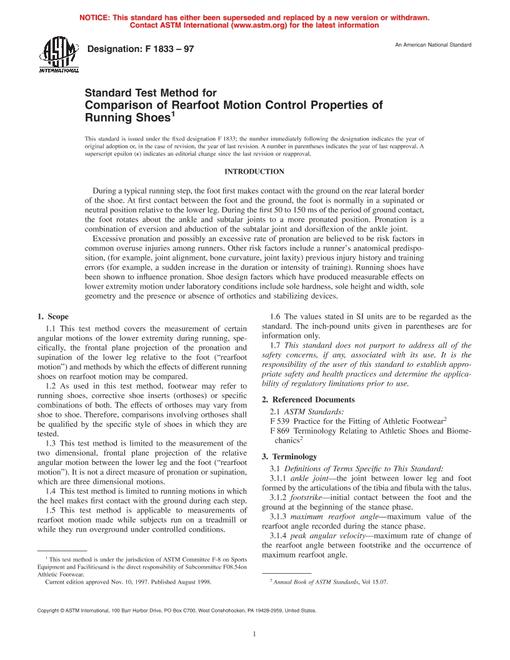
1.1 This test method covers the measurement of certain angular motions of the lower extremity during running, specifically, the frontal plane projection of the pronation and supination of the lower leg relative to the foot ("rearfoot motion") and methods by which the effects of different running shoes on rearfoot motion may be compared.

1.2 As used in this test method, footwear may refer to running shoes, corrective shoe inserts (orthoses) or specific combinations of both. The effects of orthoses may vary from shoe to shoe. Therefore, comparisons involving orthoses shall be qualified by the specific style of shoes in which they are tested.

1.3 This test method is limited to the measurement of the two dimensional, frontal plane projection of the relative angular motion between the lower leg and the foot ("rearfoot motion"). It is not a direct measure of pronation or supination, which are three dimensional motions.

1.4 This test method is limited to running motions in which the heel makes first contact with the ground during each step.

1.5 This test method is applicable to measurements of rearfoot motion made while subjects run on a treadmill or while they run overground under controlled conditions.

1.6 The values stated in SI units are to be regarded as the standard. The inch-pound units given in parentheses are for information only.

This standard does not purport to address all of the safety concerns, if any, associated with its use. It is the responsibility of the user of this standard to establish appropriate safety and health practices and determine the applicability of regulatory limitations prior to use.


File Size : 1 file , 110 KB
Note : This product is unavailable in Russia, Ukraine, Belarus
Number of Pages : 8
Published : 03/01/2006

History

ASTM F1833-97(2017)
Published Date: 09/01/2017
Standard Test Method for Comparison of Rearfoot Motion Control Properties of Running Shoes
$14.4
ASTM F1833-97(2011)
Published Date: 11/01/2011
Standard Test Method for Comparison of Rearfoot Motion Control Properties of Running Shoes
$17.4
ASTM F1833-97(2006)
Published Date: 03/01/2006
Standard Test Method for Comparison of Rearfoot Motion Control Properties of Running Shoes
$17.4
ASTM F1833-97
Published Date: 11/10/1997
Standard Test Method for Comparison of Rearfoot Motion Control Properties of Running Shoes
$17.4

Related products

ASTM F833-21
Published Date: 06/15/2021
Standard Consumer Safety Performance Specification for Carriages and Strollers
$22.5
ASTM F2223-19a
Published Date: 12/01/2019
Standard Guide for ASTM Standards on Playground Surfacing
$15
ASTM F2614-19
Published Date: 05/15/2019
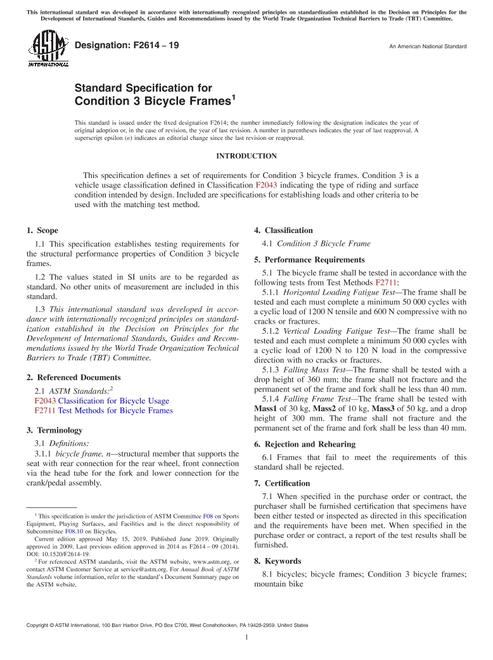
Standard Specification for Condition 3 Bicycle Frames
$12.6
ASTM F2801-19(2023)
Published Date: 04/01/2023
Standard Practice for Paintball Player Safety Briefing
$15

Best-Selling Products

SN-ISO/TR 10013:2001
Published Date: 01/14/2002
Guidelines for quality management system documentation
SN-ISO/TR 14062:2002
Published Date: 11/11/2002
Environmental management - Integrating environmental aspects into product design and development
SN-ISO/TR 14069:2013
Published Date: 06/11/2015
Greenhouse gases - Quantification and reporting of greenhouse gas emissions for organizations - Guidance for the application of ISO 14064-1
SN-ISO/TR 15489-2:2001
Published Date: 11/01/2008
Information and documentation — Records management — Part 2: Guidelines
SN-ISO/TR 15499:2012
Published Date: 07/01/2014
Biological evaluation of medical devices — Guidance on the conduct of biological evaluation within a risk management process
SN-ISO/TR 19083-1:2016
Published Date: 07/13/2023
Intelligent transport systems - Emergency evacuation and disaster response and recovery - Part 1: Framework and concept of operation