Name:
ASTM F1925-22 PDF
Published Date:
02/01/2022
Status:
Active
Publisher:
ASTM International
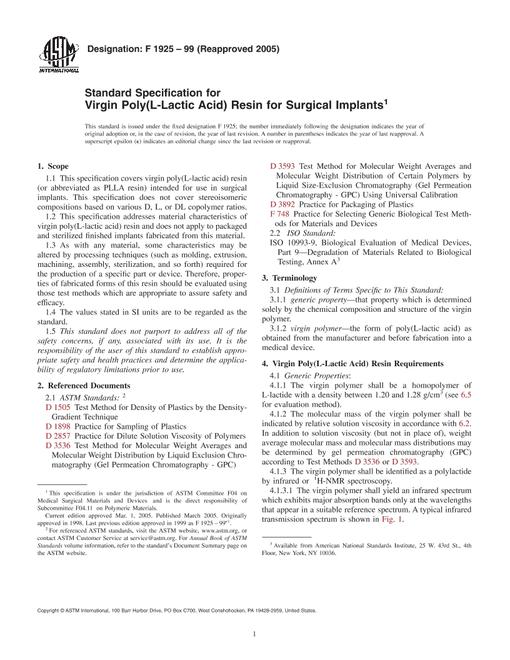
1.1''This specification covers virgin semi-crystalline poly(l-lactide) or poly(d-lactide) homopolymer resins intended for use in surgical implants. This specification also covers semi-crystalline resins of l-lactide copolymerized with other bioabsorbable monomers including, but not limited to, glycolide, d-lactide, and dl-lactide. The poly(l-lactide) or poly(d-lactide) based homopolymers and copolymers covered by this specification possess lactide segments of sufficient length to allow potential for their crystallization upon annealing.
1.2''Since poly(glycolide) is commonly abbreviated as PGA for poly(glycolic acid) and poly(lactide) is commonly abbreviated as PLA for poly(lactic acid), these polymers are commonly referred to as PGA, PLA, and PLA:PGA resins for the hydrolytic byproducts to which they respectively degrade. PLA is a term that carries no stereoisomeric specificity and therefore encompasses both the amorphous atactic/syndiotactic dl-lactide based polymers and copolymers as well as the isotactic d-PLA and l-PLA moieties, each of which carries potential for crystallization. Inclusion of stereoisomeric specificity within the lactic acid based acronyms results in the following: poly(l-lactide) as PlLA for poly(l-lactic acid), poly(d-lactide) as PdLA for poly(d-lactic acid), and poly(dl-lactide) as PdlLA for poly(dl-lactic acid).
1.3''This specification is applicable to lactide-based polymers or copolymers that possess isotactic polymeric segments sufficient in size to carry potential for lactide-based crystallization. Such polymers typically possess nominal mole fractions that equal or exceed 50'''% l-lactide. This specification is particularly applicable to isotactic-lactide based block copolymers or to polymers or copolymers synthesized from combinations of d-lactide and l-lactide that differ by more than 1.5 total mole percent (1.5'''% of total moles). This specification is not applicable to lactide-co-glycolide copolymers with glycolide mole fractions greater than or equal to 70'''% (65.3'''% in mass fraction), which are covered by Specification F2313. This specification is not applicable to amorphous polymers or copolymers synthesized from combinations of d-lactide and l-lactide that differ by less than 1.5 total mole percent (1.5'''% of total moles) as covered by Specification F2579.
1.4''This specification covers virgin semi-crystalline poly(lactide)-based resins able to be fully solvated at 30'''''C by either methylene chloride (dichloromethane) or chloroform (trichloromethane). This specification is not applicable to lactide:glycolide copolymers that possess glycolide segments sufficient in size to deliver potential for glycolide-based crystallization, thereby requiring fluorinated solvents for complete dissolution under room temperature conditions (see Specification F2313).
1.5''Within this specification, semi-crystallinity within the resin is defined by the presence of a DSC (differential scanning calorimetry) crystalline endotherm after annealing above the glass transition temperature. While other copolymeric segments may also crystallize upon annealing (for example, glycolide), specific characterization of crystalline structures other than those formed by lactide are outside the scope of this specification.
1.6''This specification addresses material characteristics of the virgin semi-crystalline poly(lactide)-based resins intended for use in surgical implants and does not apply to packaged and sterilized finished implants fabricated from these materials.
1.7''As with any material, some characteristics may be altered by processing techniques (such as molding, extrusion, machining, assembly, sterilization, and so forth) required for the production of a specific part or device. Therefore, properties of fabricated forms of this resin should be evaluated independently using appropriate test methods to ensure safety and efficacy.
1.8''Biocompatibility testing is not a requirement since this specification is not intended to cover fabricated devices.
1.9''The values stated in SI units are to be regarded as standard. No other units of measurement are included in this standard.
1.10''This standard does not purport to address all of the safety concerns, if any, associated with its use. It is the responsibility of the user of this standard to establish appropriate safety, health, and environmental practices and determine the applicability of regulatory limitations prior to use.
1.11''This international standard was developed in accordance with internationally recognized principles on standardization established in the Decision on Principles for the Development of International Standards, Guides and Recommendations issued by the World Trade Organization Technical Barriers to Trade (TBT) Committee.
| File Size : | 1 file , 170 KB |
| Note : | This product is unavailable in Russia, Ukraine, Belarus |
| Number of Pages : | 9 |
| Published : | 02/01/2022 |