Name:
ASTM F2248-09 PDF
Published Date:
11/01/2009
Status:
Active
Publisher:
ASTM International
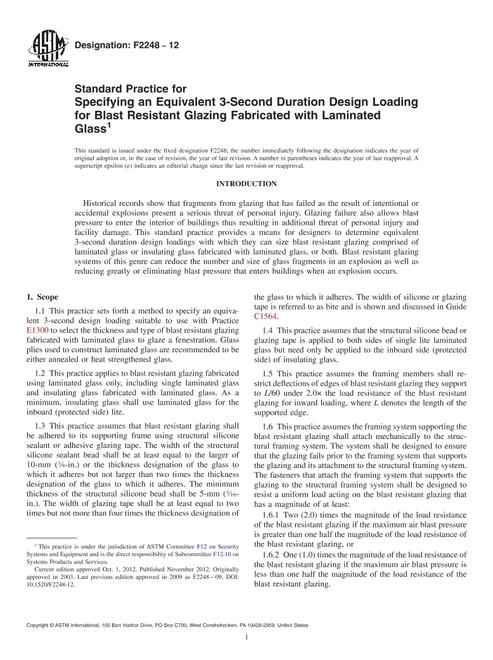
1.1 This practice sets forth a method to specify an equivalent 3-second design loading suitable to use with Practice E1300 to select the thickness and type of blast resistant glazing fabricated with laminated glass to glaze a fenestration. Glass plies used to construct laminated glass are recommended to be either annealed or heat strengthened glass.
1.2 This practice applies to blast resistant glazing fabricated using laminated glass only, including single laminated glass and insulating glass fabricated with laminated glass. As a minimum, insulating glass shall use laminated glass for the inboard (protected side) lite.
1.3 This practice assumes that blast resistant glazing shall be adhered to its supporting frame using structural silicone sealant or adhesive glazing tape. The width of the structural silicone sealant bead shall be at least equal to the larger of 10-mm (³/8-in.) or the thickness designation of the glass to which it adheres but not larger than two times the thickness designation of the glass to which it adheres. The minimum thickness of the structural silicone bead shall be 5-mm (³/16-in.). The width of glazing tape shall be at least equal to two times but not more than four times the thickness designation of the glass to which it adheres. The width of silicone or glazing tape is referred to as bite and is shown and discussed in Guide C1564.
1.4 This practice assumes that the structural silicone bead or glazing tape is applied to both sides of single lite laminated glass but need only be applied to the inboard side (protected side) of insulating glass.
1.5 This practice assumes the framing members shall restrict deflections of edges of blast resistant glazing they support to L/60 under 2.0× the load resistance of the blast resistant glazing for inward loading, where L denotes the length of the supported edge.
1.6 This practice assumes the framing system supporting the blast resistant glazing shall attach mechanically to the structural framing system. The system shall be designed to ensure that the glazing fails prior to the framing system that supports the glazing and its attachment to the structural framing system. The fasteners that attach the framing system that supports the glazing to the structural framing system shall be designed to resist a uniform load acting on the blast resistant glazing that has a magnitude of at least:
1.6.1 Two (2.0) times the magnitude of the load resistance of the blast resistant glazing if the maximum air blast pressure is greater than one half the magnitude of the load resistance of the blast resistant glazing, or
1.6.2 One (1.0) times the magnitude of the load resistance of the blast resistant glazing if the maximum air blast pressure is less than one half the magnitude of the load resistance of the blast resistant glazing.
1.7 Blast resistant glazing designed using this practice recommends the use of annealed or heat strengthened glass plies for the laminated glass. Blast testing has shown that use of fully tempered glass plies, when fractured during a blast event, have poorer post blast performance than annealled or heat strengthened glass plies. Laminated glass fabricated with fully tempered glass plies has a tendency to leave the supporting glazing system frame after fracture whereas laminated glass fabricated with annealed or heat strengthened glass plies will remain in the frame and absorb remaining load through tensile membrane behavior. Use of the annealed or heat strengthened glass plies will also reduce the amount of load transferred into the structure.
1.8 The equivalent 3-second design load as determined herein shall not apply to the design of monolithic glazing, plastic glazing, or security film applied to existing glazing configurations in an attempt to achieve blast resistance.
1.9 The values stated in SI units are to be regarded as the standard. Values given in parentheses are for information only. For conversion of quantities in various systems of measurements to SI units refer to ANSI IEEE/SI 10.
1.10 This standard does not purport to address all of the safety concerns, if any, associated with its use. It is the responsibility of the user of this standard to establish appropriate safety and health practices and determine the applicability of regulatory limitations prior to use.
| File Size : | 1 file , 100 KB |
| Note : | This product is unavailable in Russia, Ukraine, Belarus |
| Number of Pages : | 4 |
| Published : | 11/01/2009 |