Name:
ASTM F328-98 PDF
Published Date:
06/10/1998
Status:
Active
Publisher:
ASTM International
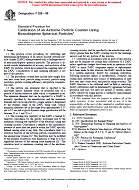
1.1 This practice covers procedures for determining both the counting and sizing accuracy for an automatic airborne particle counter (APC). The practice is directed towards determination of the sizing accuracy and resolution of the APC when presented with a challenge aerosol of near monosized spherical particles. The practice is also directed towards determination of the counting accuracy of an automatic particle counter for spherical particles that have entered the sampling inlet of that particle counter. Consideration of sampling efficiency effects is not part of this test procedure.
1.2 The size distribution parameter that is reported is the equivalent optical diameter based on projected area of a spherical particle of known refractive index. The minimum diameter that can be effectively measured by an automatic airborne particle counter is specified by the manufacturer, and the maximum diameter that can be measured on a single sample is determined by the dynamic range of the instrument being used. Typical minimum diameters are in the range from 0.2 to 0.5 [mu]m and typical dynamic range specification is 40 to 1.
1.3 The counting rate capability of the APC is limited by physical coincidence for the specific instrument, and by the maximum counting rate capability of the electronic counting circuitry. Coincidence is defined as the probability that more than one particle will be present in the sensing zone at any time. The coincidence error is a statistical function of the concentration and the sensing zone volume. The saturation level, or maximum counting rate of the electronic counting circuitry, will be specified by the manufacturer and should always be higher than the APC counting rate at the specified maximum concentration.
1.4 This standard may involve hazardous materials, operations, and equipment. This standard does not purport to address all of the safety problems associated with its use. It is the responsibility of the user of this standard to establish appropriate safety and health practices and determine the applicability of regulatory limitations prior to use.
| File Size : | 1 file , 120 KB |
| Note : | This product is unavailable in Russia, Ukraine, Belarus |
| Number of Pages : | 11 |
| Published : | 06/10/1998 |