AWWA ACE54532 PDF

AWWA ACE54532 PDF

Name:
AWWA ACE54532 PDF

Published Date:
06/01/2001

Status:
Active

Description:

Options for Microorganism Reduction for Cold Water Utilities

Publisher:
American Water Works Association

Document status:
Active

Format:
Electronic (PDF)

Delivery time:
10 minutes

Delivery time (for Russian version):
200 business days

SKU:

Choose Document Language:
$7.2
Need Help?
Utilities operating in cold regions face several challenges in the provision of microbiologically safe drinking water. In particular, these utilities must account for the low temperature of their source water in the design and operation of their water treatment processes. In some locations, source water temperature may approach 0 degrees C for extended periods during the year. Water at this temperature creates a dilemma for utilities that must meet reduction requirements for Giardia lamblia and Cryptosporidium parvum. At low temperatures, the cysts and oocysts of these parasites are extremely resistant to most conventional chemical treatments. In this paper, the design requirements for control of these parasites in low temperature waters by conventional chemical treatment methods, including chlorine, monochloramine and chlorine dioxide, will be reviewed. Ozone and ultraviolet (UV) light are two potential solutions to the problem of G. lamblia and C. parvum reduction for cold regions. The results of a recent laboratory study on the efficacy of ozone and ultraviolet light (UV) for inactivation of C. parvum at very low water temperature will be summarized. A kinetic model that predicts inactivation of C. parvum by ozone at various temperatures will be described. The model can be used by designers of water treatment facilities in cold regions to generate ozone design criteria for inactivation of C. parvum for water temperature as low as 1 degree C. In contrast to chemical treatments, temperature had little effect on inactivation of C. parvum oocysts by UV light at temperatures ranging from 0.5 to 22 degrees C. High levels of oocyst inactivation were measured in 0.5C water at UV doses as low 10 to 21 mJ/cm 2. Includes 17 references, figures.
Edition : Vol. - No.
File Size : 1 file , 360 KB
Note : This product is unavailable in Ukraine, Russia, Belarus
Number of Pages : 13
Published : 06/01/2001

History


Related products

AWWA ACE54322
Published Date: 06/01/2001
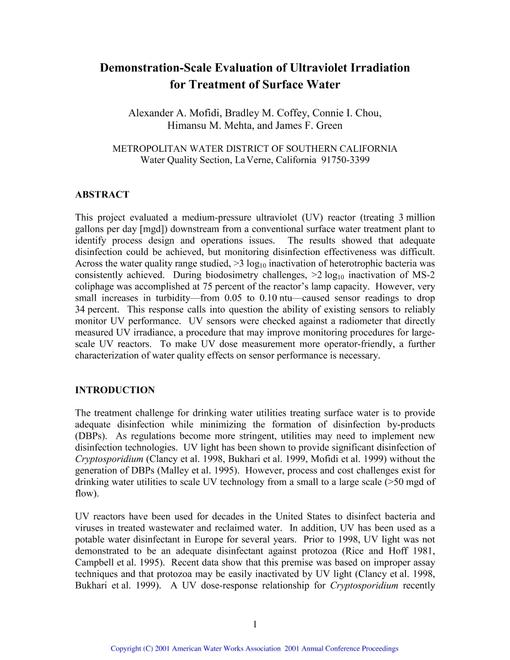
Demonstration-Scale Evaluation of Ultraviolet Irradiation for Treatment of Surface Water
$7.2
AWWA ACE54521
Published Date: 06/01/2001
Disincentive Fee for Groundwater Withdrawal
$7.2
AWWA ACE54346
Published Date: 06/01/2001
Effects of Activated Carbon Surface Chemistry and Pore Structure on the Adsorption of Methyl Tertiary-Butyl Ether and Trichloroethene From Natural Water
$7.2
AWWA ACE54416
Published Date: 06/01/2001
Direct Laboratory Reporting of Compliance Data--Does it Make a Difference?
$7.2

Best-Selling Products

ISO/TS 10004:2010
Published Date: 04/15/2010
Quality management - Customer satisfaction - Guidelines for monitoring and measuring
$42.6
ISO/TS 10020:2022
Published Date: 08/31/2022
Quality management systems - Organizational change management - Processes
$66.9
ISO/TS 10128:2009
Published Date: 07/01/2009
Graphic technology - Methods of adjustment of the colour reproduction of a printing system to match a set of characterization data
$23.1
ISO/TS 10128:2023
Published Date: 11/01/2023
Graphic technology - Methods of adjustment of the colour reproduction of a printing system to match a set of characterization data
$37.2
ISO/TS 10272-2:2006
Published Date: 01/15/2006
Microbiology of food and animal feeding stuffs - Horizontal method for detection and enumeration of Campylobacter spp. - Part 2: Colony-count technique
$30.9
ISO/TS 10272-3:2010
Published Date: 03/01/2010
Microbiology of food and animal feeding stuffs - Horizontal method for detection and enumeration of Campylobacter spp. - Part 3: Semi-quantitative method
$33.6