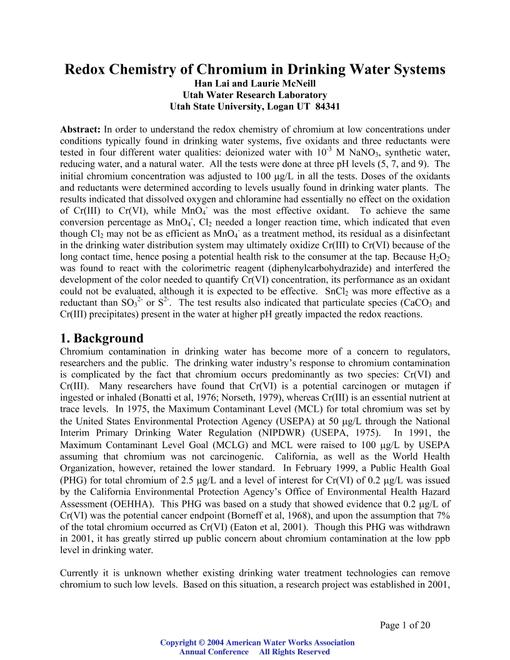
In order to understand the redox chemistry of chromium at low concentrations under
conditions typically found in drinking water systems, five oxidants and three reductants were
tested in four different water qualities: deionized water with 10-3 M NaNO3; synthetic water;
reducing water; and, a natural water. All the tests were done at three pH levels (5, 7, and 9). The
initial chromium concentration was adjusted to 100 µg/L in all the tests. Doses of the oxidants
and reductants were determined according to levels usually found in drinking water plants. The
results indicated that dissolved oxygen and chloramine had essentially no effect on the oxidation
of Cr(III) to Cr(VI), while MnO4- was the most effective oxidant. To achieve the same
conversion percentage as MnO4-, Cl2 needed a longer reaction time, which indicated that even
though Cl2 may not be as efficient as MnO4- as a treatment method, its residual as a disinfectant
in the drinking water distribution system may ultimately oxidize Cr(III) to Cr(VI) because of the
long contact time, hence posing a potential health risk to the consumer at the tap. Because H2O2
was found to react with the colorimetric reagent (diphenylcarbohydrazide) and interfered the
development of the color needed to quantify Cr(VI) concentration, its performance as an oxidant
could not be evaluated, although it is expected to be effective. SnCl2 was more effective as a
reductant than SO32- or S2-. The test results also indicated that particulate species (CaCO3 and
Cr(III) precipitates) present in the water at higher pH greatly impacted the redox reactions.
Includes 17 references, tables, figures.
| Edition : | Vol. - No. |
| File Size : | 1
file
, 420 KB |
| Note : | This product is unavailable in Ukraine, Russia, Belarus |
| Number of Pages : | 20 |
| Published : | 06/17/2004 |