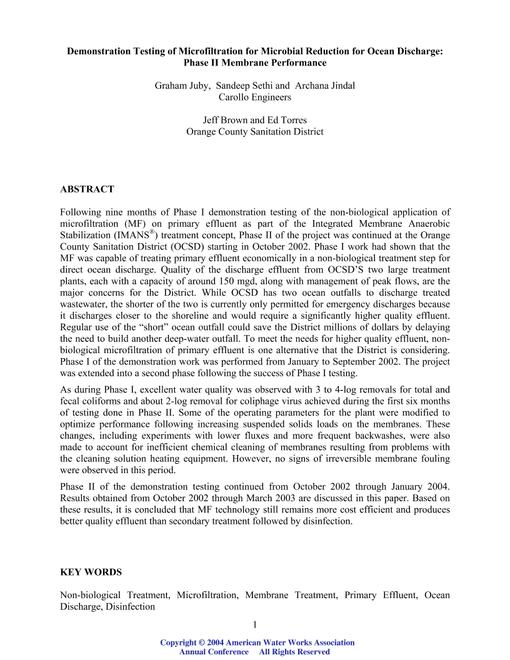
Following nine months of Phase I demonstration testing of the non-biological application of
microfiltration (MF) on primary effluent as part of the Integrated Membrane Anaerobic
Stabilization (IMANS®) treatment concept, Phase II of the project was continued at the Orange
County Sanitation District (OCSD) starting in October 2002. Phase I work had shown that the
MF was capable of treating primary effluent economically in a non-biological treatment step for
direct ocean discharge. Quality of the discharge effluent from OCSD'S two large treatment
plants, each with a capacity of around 150 mgd, along with management of peak flows, are the
major concerns for the District. While OCSD has two ocean outfalls to discharge treated
wastewater, the shorter of the two is currently only permitted for emergency discharges because
it discharges closer to the shoreline and would require a significantly higher quality effluent.
Regular use of the "short" ocean outfall could save the District millions of dollars by delaying
the need to build another deep-water outfall. To meet the needs for higher quality effluent, nonbiological
microfiltration of primary effluent is one alternative that the District is considering.
Phase I of the demonstration work was performed from January to September 2002. The project
was extended into a second phase following the success of Phase I testing.
As during Phase I, excellent water quality was observed with 3 to 4-log removals for total and
fecal coliforms and about 2-log removal for coliphage virus achieved during the first six months
of testing done in Phase II. Some of the operating parameters for the plant were modified to
optimize performance following increasing suspended solids loads on the membranes. These
changes, including experiments with lower fluxes and more frequent backwashes, were also
made to account for inefficient chemical cleaning of membranes resulting from problems with
the cleaning solution heating equipment. However, no signs of irreversible membrane fouling
were observed in this period.
Phase II of the demonstration testing continued from October 2002 through January 2004.
Results obtained from October 2002 through March 2003 are discussed in this paper. Based on
these results, it is concluded that MF technology still remains more cost efficient and produces
better quality effluent than secondary treatment followed by disinfection. Includes 2 references, figures.
| Edition : | Vol. - No. |
| File Size : | 1
file
, 440 KB |
| Note : | This product is unavailable in Ukraine, Russia, Belarus |
| Number of Pages : | 11 |
| Published : | 06/17/2004 |