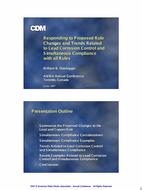
This powerpoint presentation outlines topics that include: summarize the proposed changes to the
Lead and Copper Rule;
Simultaneous Compliance Considerations; Simultaneous Compliance Examples;
Trends Related to Lead Corrosion Control
and Simultaneous Compliance; and,
Recent Examples Related to Lead Corrosion
Control and Simultaneous Compliance. Conclusions were that:
Recent Lead Detections and Investigations in
Washington DC, Durham NC and other Locations
Reveal Simultaneous Compliance Issues with the
DBPR and Lead and Copper Rule;
Recently Developed Materials such as the MDBP
Simultaneous Compliance Guidance Manual
Should be Consulted before Making any
Significant Process Changes;
Changes in oxidant/disinfectant and coagulant
Cl:SO4 ratio have been found to impact lead
corrosion significantly, past guidance on lead
corrosion showed impacts of pH, inhibitors such
as phosphates and silicates, hardness, alkalinity,
total dissolved solids, bio-corrosion, etc.;
Proposed Changes to the Lead and Copper Rule
Seek to Help Address Recent Trends by measures
such as
preventing water systems above the lead action
level from remaining on a reduced schedule based
on maintaining Water Quality parameters, and
requiring water systems to provide advanced
notice to the primacy agency of intended changes
in treatment or source water that could increase
corrosion of lead; and,
make only one major process change at a time and
evaluate corrosion control before and after each
change.
| Edition : | Vol. - No. |
| File Size : | 1
file
, 1.2 MB |
| Note : | This product is unavailable in Ukraine, Russia, Belarus |
| Number of Pages : | 14 |
| Published : | 06/01/2007 |