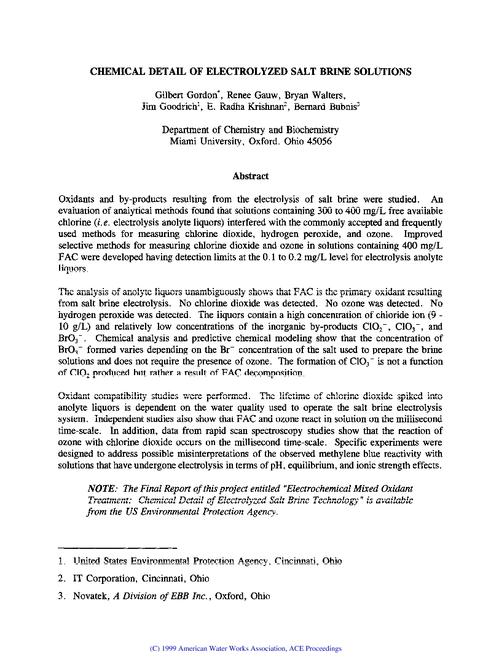
Oxidants and byproducts resulting from the electrolysis of salt brine were studied. An evaluation of analytical methods found that solutions containing 300 to 400 mg/L free available chlorine (i.e. electrolysis anolyte liquors) interfered with the commonly accepted and frequently used methods for measuring chlorine dioxide, hydrogen peroxide, and ozone. Improved selective methods for measuring chlorine dioxide and ozone in solutions containing 400 mg/L FAC were developed having detection limits at the 0.1 to 0.2 mg/L level for electrolysis anolyte liquors. The analysis of anolyte liquors proved that FAC is the primary oxidant resulting from salt brine electrolysis. No chlorine dioxide was detected. No ozone was detected. No hydrogen peroxide was detected. The liquors contain a high concentration of chloride ion (9-10 g/L) and relatively low concentrations of the inorganic byproducts C102-, C103-, and Br03-. Chemical analysis and predictive chemical modeling show that the concentration of Br03- formed varies depending on the Br- concentration of the salt used to prepare the brine solutions and does not require the presence of ozone. The formation of C103- is not a function of C102 produced but rather a result of FAC decomposition. Oxidant compatibility studies were performed. The lifetime of chlorine dioxide spiked into anolyte liquors is dependent on the water quality used to operate the salt brine electrolysis system. Independent studies also show that FAC and ozone react in solution on the millisecond time-scale. In addition, data from rapid scan spectroscopy studies show that the reaction of ozone with chlorine dioxide occurs on the millisecond time-scale. Specific experiments were designed to address possible misinterpretations of the observed methylene blue reactivity with solutions that have undergone electrolysis in terms of pH, equilibrium, and ionic strength effects.
| File Size : | 1
file
, 1.5 MB |
| ISBN(s) : | 1583210016 |
| Note : | This product is unavailable in Ukraine, Russia, Belarus |
| Number of Pages : | 20 |
| Published : | 01/01/1999 |