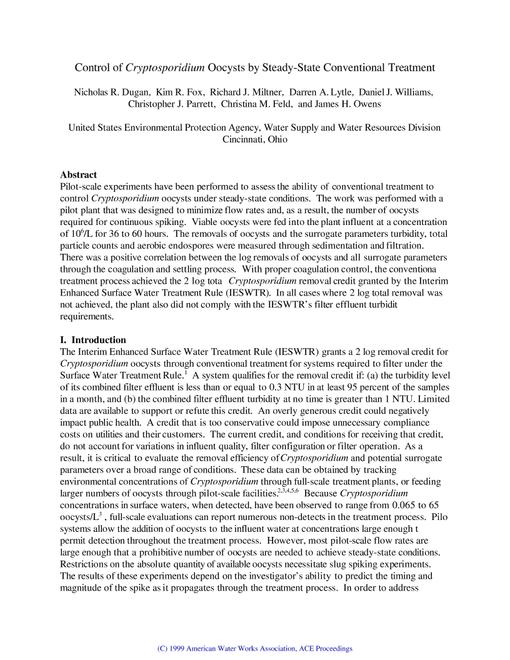
Pilot-scale experiments have been performed to assess the ability of conventional treatment to control Cryptosporidium oocysts under steady-state conditions. The work was performed with a pilot plant that was designed to minimize flow rates and the number of oocysts required for continuous spiking. Viable oocysts were fed into the plant influent at a concentration of 106/L for 36 to 60 hours. The removals of oocysts and the surrogate parameters turbidity, total particle counts, and aerobic endospores were measured through sedimentation and filtration. There was a positive correlation between the log removals of oocysts and all surrogate parameters through the coagulation and settling process. With proper coagulation control, the conventional treatment process achieved the 2 log total Cryptosporidium removal credit granted by the Interim Enhanced Surface Water Treatment Rule (IESWTR). In all cases where 2 log total removal was not achieved, the plant also did not comply with the IESWTR's filter effluent turbidity requirements.
| File Size : | 1
file
, 230 KB |
| ISBN(s) : | 1583210016 |
| Note : | This product is unavailable in Ukraine, Russia, Belarus |
| Number of Pages : | 19 |
| Published : | 01/01/1999 |