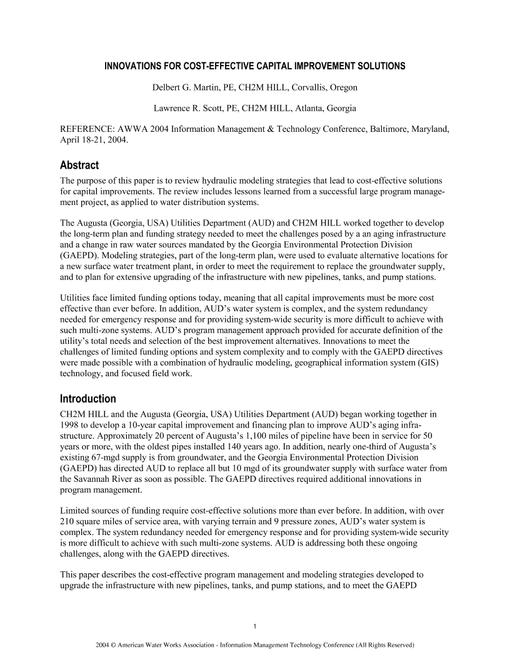
The purpose of this paper is to review hydraulic modeling strategies that lead to cost-effective solutions
for capital improvements. The review includes lessons learned from a successful large program management
project, as applied to water distribution systems.
The Augusta (Georgia, USA) Utilities Department (AUD) and CH2M HILL worked together to develop
the long-term plan and funding strategy needed to meet the challenges posed by a an aging infrastructure
and a change in raw water sources mandated by the Georgia Environmental Protection Division
(GAEPD). Modeling strategies, part of the long-term plan, were used to evaluate alternative locations for
a new surface water treatment plant, in order to meet the requirement to replace the groundwater supply,
and to plan for extensive upgrading of the infrastructure with new pipelines, tanks, and pump stations.
Utilities face limited funding options today, meaning that all capital improvements must be more cost
effective than ever before. In addition, AUD's water system is complex, and the system redundancy
needed for emergency response and for providing system-wide security is more difficult to achieve with
such multi-zone systems. AUD's program management approach provided for accurate definition of the
utility's total needs and selection of the best improvement alternatives. Innovations to meet the
challenges of limited funding options and system complexity and to comply with the GAEPD directives
were made possible with a combination of hydraulic modeling, geographical information system (GIS)
technology, and focused field work. Includes tables, figures.
| Edition : | Vol. - No. |
| File Size : | 1
file
, 1.5 MB |
| Note : | This product is unavailable in Ukraine, Russia, Belarus |
| Number of Pages : | 15 |
| Published : | 04/18/2004 |