AWWA MTC61143 PDF

AWWA MTC61143 PDF

Name:
AWWA MTC61143 PDF

Published Date:
03/01/2005

Status:
Active

Description:

Evaluating Chloramines for Control of RO Membrane Biofouling with Ground and Surface Water Supplies

Publisher:
American Water Works Association

Document status:
Active

Format:
Electronic (PDF)

Delivery time:
10 minutes

Delivery time (for Russian version):
200 business days

SKU:

Choose Document Language:
$7.2
Need Help?
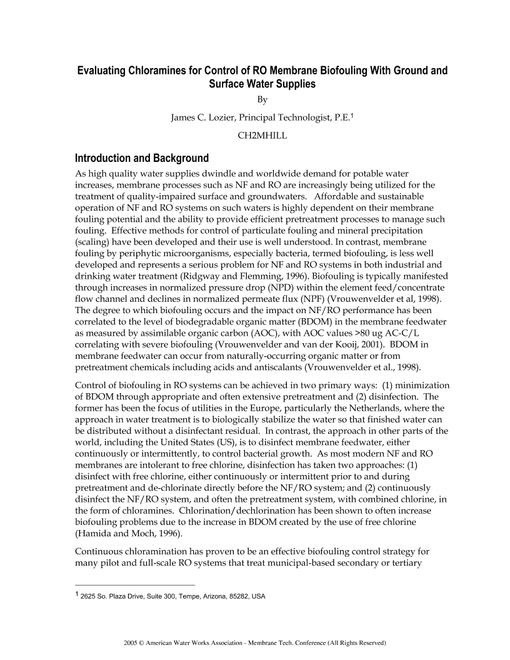
This paper describes the results of two pilot studies in which continuous chloramination was evaluated for control of biofouling during reverse osmosis (RO) treatment of a brackish groundwater (Study A), and a surface water (Study B). Study A comprised the testing of RO treatment for demineralization of an aerated groundwater contaminated with trichloroethylene (TCE) for the removal of total dissolved solids (TDS), nitrate and arsenic. A major concern in the application of RO to this groundwater was the potential for biological fouling due to the elevated dissolved oxygen content (from air stripping of the groundwater to remove the TCE) and presence of trace levels of assimilable organic matter from groundwater pollution. To address this concern, a pilot study was conducted to determine to what extent biofouling would occur and to assess the ability of continuous chloramination to control biofouling without causing any membrane degradation. The paper provides a schematic for the pilot-scale treatment process used. The surface water used in Study B pilot testing was taken from Lake Monroe, one of many lakes located along the St. Johns River, which drains the watershed located in the northeastern portion of Florida. The paper provides the mean, maximum and minimum values for key water quality parameters of the lake water as measured during the sampling period January 2000 to August 2002. RO treatment was evaluated to remove color, reduce dissolved organic carbon (DOC) levels (to ensure compliance with disinfection byproduct regulations following free chlorine disinfection) and to reduce TDS to <400 mg/L to match the minerality of existing groundwater supplies. To comply with the Surface Water Treatment Rule (SWTR) and to minimize RO membrane fouling, the lake water was first pretreated using ferric sulfate coagulation, high rate clarification (SuperPulsator) and granular media filtration. Ferric sulfate was dosed prior to rapid mix along with either sulfuric acid or caustic to attain a pH of 4.3 to optimize DOC removal. A cationic polymer was also added to improve floc settleability. During the first portion of testing (0 to 900 hours), ammonia, followed by chlorine, were dosed to the raw water prior to ferric sulfate addition to achieve a target combined chlorine residual of 1.0 mg/L as measured in the filter effluent. From 900 hours to the end of testing, the point of chloramination was re-located to filter influent based on changes in RO performance. The paper includes the overall process schematic for the Study B treatment system. Includes 7 references, tables, figures.
Edition : Vol. - No.
File Size : 1 file , 870 KB
Note : This product is unavailable in Ukraine, Russia, Belarus
Number of Pages : 16
Published : 03/01/2005

History


Related products

AWWA MTC61093
Published Date: 03/01/2005
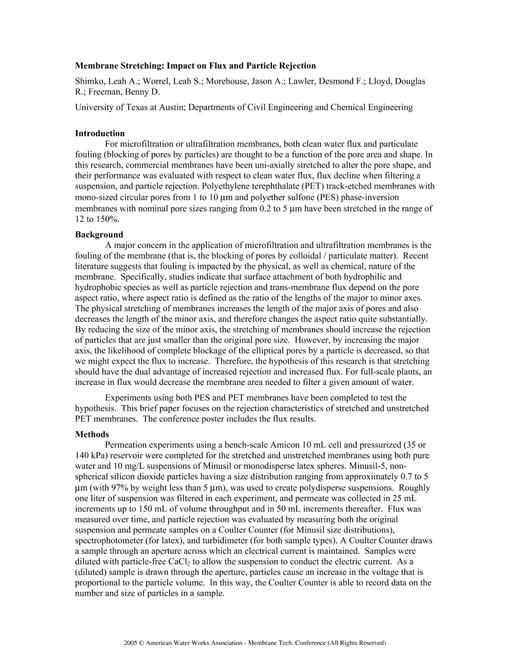
Membrane Stretching: Impact on Flux and Particle Rejection
$7.2
AWWA MTC61118
Published Date: 03/01/2005
Membrane Separation of Ion Exchange Resin
$7.2
AWWA MTC61160
Published Date: 03/01/2005
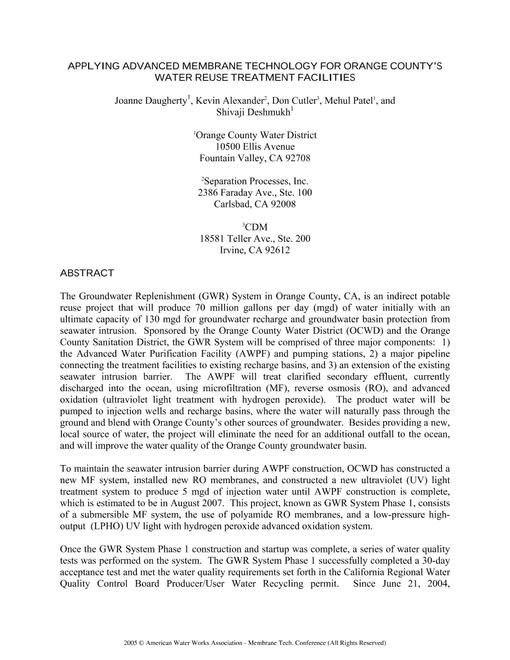
Applying Advanced Membrane Technology for Orange County's Water Reuse Treatment Facilities
$7.2
AWWA MTC61179
Published Date: 03/01/2005
MBRs Provide Reuse Solutions for Two California Communities
$7.2

Best-Selling Products