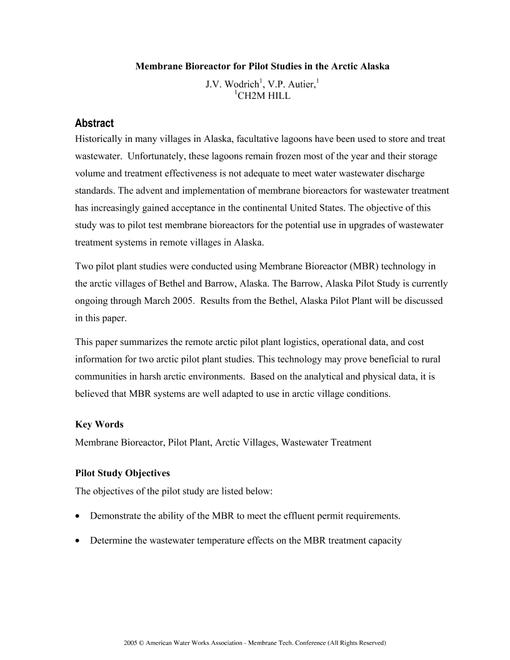
Historically in many villages in Alaska, facultative lagoons have been used to store and treat
wastewater. Unfortunately, these lagoons remain frozen most of the year and their storage
volume and treatment effectiveness is not adequate to meet water wastewater discharge
standards. The advent and implementation of membrane bioreactors for wastewater treatment
has increasingly gained acceptance in the continental United States. The objective of this
study was to pilot test membrane bioreactors for the potential use in upgrades of wastewater
treatment systems in remote villages in Alaska. Specific objectives include:
demonstrate the ability of the MBR to meet the effluent permit requirements;
determine the wastewater temperature effects on the MBR treatment capacity; provide opportunities to further define design criteria, verify and reduce costs, and
determine operations and maintenance (O&M) requirements and costs for the proposed
system;
demonstrate the fecal coliform removal of the system through routine monitoring of the
effluent; and,
determine the feasibility of UV disinfection of the permeate.
The pilot facility was intended to demonstrate that the proposed MBR system will provide a high level of treatment consistent with or higher than the permitting requirements.
Two pilot plant studies were conducted using Membrane Bioreactor (MBR) technology in
the arctic villages of Bethel and Barrow, Alaska. The Barrow, Alaska Pilot Study is currently
ongoing through March 2005. Results from the Bethel, Alaska Pilot Plant are discussed
in this paper.
This paper summarizes the remote arctic pilot plant logistics, operational data, and cost
information for two arctic pilot plant studies. This technology may prove beneficial to rural
communities in harsh arctic environments. Based on the analytical and physical data, it is
believed that MBR systems are well adapted to use in arctic village conditions. Includes 3 references, tables, figures.
| Edition : | Vol. - No. |
| File Size : | 1
file
, 700 KB |
| Note : | This product is unavailable in Ukraine, Russia, Belarus |
| Number of Pages : | 17 |
| Published : | 03/01/2005 |