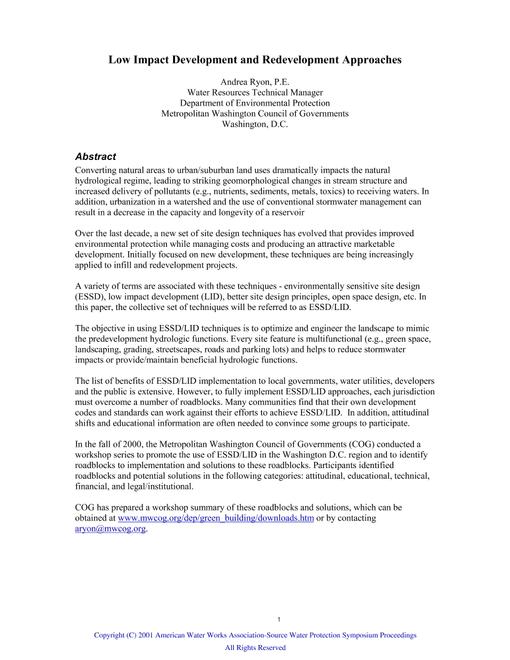
Converting natural areas to urban/suburban land uses dramatically impacts thenatural hydrologic regime, leading to striking geomorphological changes instream structure and increased delivery of pollutants (e.g., nutrients,sediments, metals, toxics) to receiving waters. In addition, urbanization in awatershed and the use of conventional storm water management can result in adecrease in the capacity and longevity of a reservoir over the last decade, a newset of site design techniques has evolved that provides improved environmentalprotection while managing costs and producing an attractive marketabledevelopment. Initially focused on new development, these techniques are beingincreasingly applied to infill and redevelopment projects. A variety of terms areassociated with these techniques - environmentally sensitive site design (ESSD),low impact development (LID), better site design principles, open space design,etc. In this paper, the collective set of techniques will be referred to asESSD/LID. The objective in using ESSD/LID techniques is to optimize and engineerthe landscape to mimic the predevelopment hydrologic functions. Every sitefeature is multifunctional (e.g., green space, landscaping, grading,streetscapes, roads and parking lots) and helps to reduce storm water impacts orprovide/maintain beneficial hydrologic functions. The list of benefits ofESSD/LID implementation to local governments, water utilities, developers and thepublic is extensive. However, to fully implement ESSD/LID approaches, eachjurisdiction must overcome a number of roadblocks. Many communities find thattheir own development codes and standards can work against their efforts toachieve ESSD/LID. In addition, attitudinal shifts and educational information areoften needed to convince some groups to participate. In the fall of 2000, theMetropolitan Washington Council of Governments (COG) conducted a workshop seriesto promote the use of ESSD/LID in the Washington D.C. region and to identifyroadblocks to implementation and solutions to these roadblocks. Participantsidentified roadblocks and potential solutions in the following categories:attitudinal, educational, technical, financial, and legal/institutional. Includes 5 references, tables.
| Edition : | Vol. - No. |
| File Size : | 1
file
, 160 KB |
| Note : | This product is unavailable in Ukraine, Russia, Belarus |
| Number of Pages : | 5 |
| Published : | 01/01/2001 |