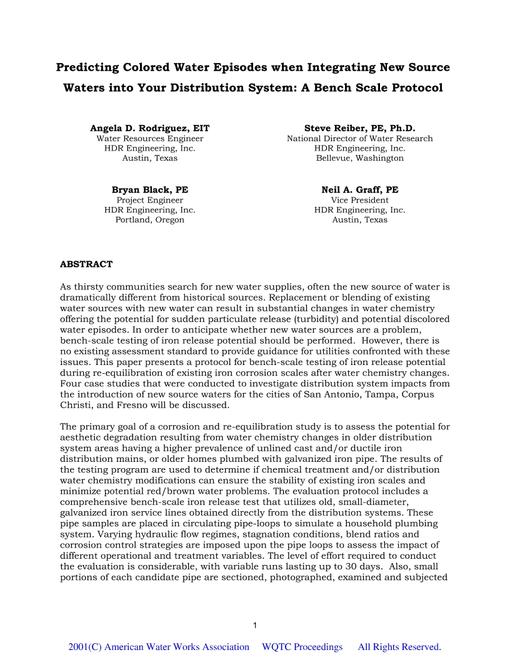
As thirsty communities search for new water supplies, often the new source of water is dramatically different from historical sources. Replacement or blending of existing water sources with new water can result in substantial changes in water chemistry offering the potential for sudden particulate release (turbidity) and potential discolored water episodes. In order to anticipate whether new water sources are a problem, bench-scale testing of iron release potential should be performed. However, there is no existing assessment standard to provide guidance for utilities confronted with these issues. This paper presents a protocol for bench-scale testing of iron release potential during re-equilibration of existing iron corrosion scales after water chemistry changes. Four case studies that were conducted to investigate distribution system impacts from the introduction of new source waters for the cities of San Antonio, Tampa, Corpus Christi, and Fresno are discussed in this paper. The primary goal of a corrosion and re-equilibration study is to assess the potential for aesthetic degradation resulting from water chemistry changes in older distribution system areas having a higher prevalence of unlined cast and/or ductile iron distribution mains, or older homes plumbed with galvanized iron pipe. The results of the testing program are used to determine if chemical treatment and/or distribution water chemistry modifications can ensure the stability of existing iron scales and minimize potential red/brown water problems. The evaluation protocol includes a comprehensive bench-scale iron release test that utilizes old, small-diameter, galvanized iron service lines obtained directly from the distribution systems. These pipe samples are placed in circulating pipe-loops to simulate a household plumbing system. Varying hydraulic flow regimes, stagnation conditions, blend ratios and corrosion control strategies are imposed upon the pipe loops to assess the impact of different operational and treatment variables. The level of effort required to conduct the evaluation is considerable, with variable runs lasting up to 30 days. Also, small portions of each candidate pipe are sectioned, photographed, examined and subjected to Scanning Electron Microscopy to characterize the composition of the existing corrosion scales in the pipes. The release of soluble and particulate iron is used as the principle indicator of potential red water generating conditions. Low, moderate and high iron release rate ranges keyed to the likelihood of developing colored water problems under the baseline and blend scenarios are developed as part of the protocol. These iron release rate guidelines are applicable to other established water systems considering replacing or amending existing source waters. To illustrate the protocol, case study evaluations for San Antonio, Texas; Tampa, Florida; Corpus Christi, Texas; and, Fresno, California are presented. Case study discussion includes review of existing and future source water characteristics, distribution system characteristics, and the findings from each evaluation, including potential impacts of various proposed blending scenarios and necessary mitigation techniques. Includes 13 references, figures.
| Edition : | Vol. - No. |
| File Size : | 1
file
, 400 KB |
| Note : | This product is unavailable in Ukraine, Russia, Belarus |
| Number of Pages : | 16 |
| Published : | 01/01/2001 |