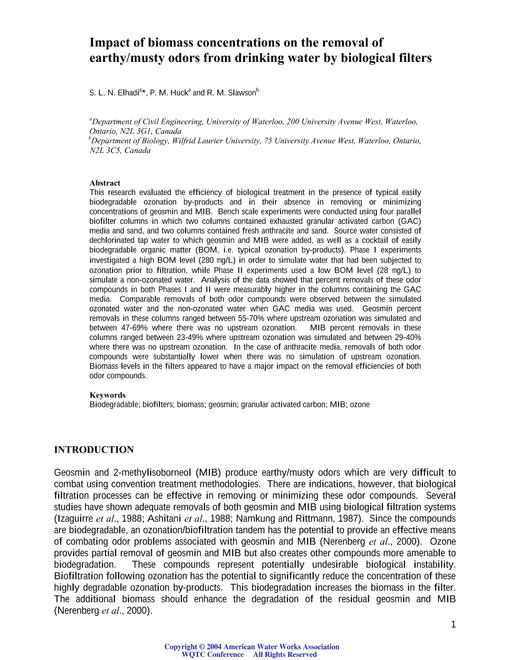
This research evaluated the efficiency of biological treatment in the presence of typical easily
biodegradable ozonation byproducts and in their absence in removing or minimizing
concentrations of geosmin and MIB. Bench scale experiments were conducted using four parallel
biofilter columns in which two columns contained exhausted granular activated carbon (GAC)
media and sand, and two columns contained fresh anthracite and sand. Source water consisted of
dechlorinated tap water to which geosmin and MIB were added, as well as a cocktail of easily
biodegradable organic matter (BOM, i.e. typical ozonation byproducts). Phase I experiments
investigated a high BOM level (280 mg/L) in order to simulate water that had been subjected to
ozonation prior to filtration, while Phase II experiments used a low BOM level (28 mg/L) to
simulate a non-ozonated water. Analysis of the data showed that percent removals of these odor
compounds in both Phases I and II were measurably higher in the columns containing the GAC
media. Comparable removals of both odor compounds were observed between the simulated
ozonated water and the non-ozonated water when GAC media was used. Geosmin percent
removals in these columns ranged between 55-70% where upstream ozonation was simulated and
between 47-69% where there was no upstream ozonation. MIB percent removals in these
columns ranged between 23-49% where upstream ozonation was simulated and between 29-40%
where there was no upstream ozonation. In the case of anthracite media, removals of both odor
compounds were substantially lower when there was no simulation of upstream ozonation.
Biomass levels in the filters appeared to have a major impact on the removal efficiencies of both
odor compounds. Includes 17 references, figures.
| Edition : | Vol. - No. |
| File Size : | 1
file
, 1.8 MB |
| Note : | This product is unavailable in Ukraine, Russia, Belarus |
| Number of Pages : | 56 |
| Published : | 11/15/2004 |